Saturday, 4 June 2011

Temminck's Stint and calling Quail

After many years of enjoying seeing birds wherever and whenever, I have become afflicted by a growing concern about lists. Previously it did not bother me at all that I had seen neither Temminck's Stint nor Quail in Scotland, never mind Lothian, since I had seen (or, in the case of Quail, heard) them on the continent and elsewhere in the UK. For me, the excitement in birding was always in the seeking, rather than in rows of ticks or within an inventory of long-gone birds listed within geographical or political boundaries. But something has changed, and I find myself increasingly irritated by the fact that after over 15 years in Scotland there are some pretty common species that I have yet to connect with within its boundaries. Whatever, something made me check my email just after lighting yesterday's barbecue, and sure enough Dave A had found yet another good bird - this time a Temminck's Stint at Musselburgh lagoons.

I have never been very good at twitching, and this was no exception. Rather than drop everything it was several hours later that I left for Musselburgh. On arrival, of course, the bird had just disappeared. I started searching diligently but soon found myself distracted by a compact gull feeding frenzy in the Firth of Forth - I could just make out some sort of cetacean in the water when I heard a dry Lapland Bunting-like trrrrrt call. Hmmm, I thought.... Slowly it dawned on me that that had been the Temminck's Stint. Even more slowly I remembered that my Remembird has a library playback function and soon enough had confirmed that the call was that of the stint. Now, that was a quandry, could I tick on call alone|? Well, I have in the past for Corncrake, for example, and the frustratingly elusive Reunion Cuckoo-shrike... But this was a stint - no-one adds stints to their national list on call alone, do they? Luckily the quandry was solved sometime later, when altered by the call one more time, the Temminck's dropped in flashing its white outer tail feathers at the back of one of the scrapes and proceeded to feed in its slow deliberate fashion on the abundant hatch of flies and the muddy edge. Long bodied and pale legged, the bird showed better than the photo above would indicate (hope you can spot it skulking behind the Lapwings).

By this time, the evening was well advanced, and since the weather was so still and warm it seemed an ideal opportunity to take up my self-set challenge of finding a Quail. 
As it turned out it didn't take long, a couple of stops along lanes threading their way between agricultural fields in the Fenton Barns area of East Lothian produced three singing Quail. Once more the Remembird was out, this time recording. Here is last night's closest bird with the soundfile popped into Ravenlite to produce a sonogram - not particularly clear, but 4x 'wet-my-lips' clearly visible in this clip - a directional microphone, parabolic reflector and wind shield would all help methinks! Now, that was the second Scottish tick of the evening, and the second of which to be identified on call - any quandry here? Not in the least - everyone adds Quail to their lists on call alone, don't they?

Thursday, 2 June 2011

What May have been...


May, like any month, had its misses. I was hoping to see the escaped White Stork flying over the back garden (probably visible twice during the month) but it managed to evade me. (The bird above is a wild bird photographed in 2009 in Andalucia.) More galling perhaps were the Red Kite and Little Egret seen by others in the vicinity - both almost certainly garden ticks there for the taking. Of course, with the cold and windy weather that predominated for the latter half of the month there was little opportunity for garden birding.

In terms of Lothian listing, at least 187 species have now been recorded in 2011 (186 on Bubo plus Spoonbill). Mike H is still heading up the Lothian listing leaderboard this year with 177 species, a great tally given his comment that he is not listing this year. I have only managed 141 of these, but that represents a leap of 22 species during the month of May. Still plenty of obvious targets to keep my interest up as we approach June. Jay, for example, is still conspicuously absent - I just have not spent any real time in the correct habitat (i.e. woodland!). My chief target for June will be hearing Quail, a species I haven't yet recorded in Scotland. Again, it is a question of spending time in the appropriate habitat in the appropriate part of the region. Of course, I'm not thinking that I'm actually going to see one, but hearing the 'wet my lips' song should not be impossible...

Best birds of the month for me ... well, I cannot complain about a garden tick (Lesser Whitethroat) and a patch tick (Tree Pipit), but easily my best bird was the male Grey-headed Wagtail at Whitesands Bay last weekend. Just kicking myself that I didn't really manage to get shots that a more than a few blurry pixels - an utterly stunning bird - just needed that camera out of the bag before I got out of the car... ah well, next time...

Sunday, 29 May 2011

Male Grey-headed Wagtail at Whitesands

A sprinkling of goodies from the Northern Isles to Northumberland yesterday had me itching to get to the coast so I set my alarm and was up and out early. Whitesands Bay was my first stop and after checking the triangle and bushes down towards Vaults without success I decided to head towards Barns Ness. I hadn't got very far when on a whim I decided to pull over and check the Bay. As I got out of the car a neon bird caught my eye close by on the close cropped turf path running through the marram grass - a cracking male Grey-headed Wagtail (thunbergi) only 10 metres away. We both froze and I slowly tried to extricate my camera from my shoulder bag. That was enough for it and it flew towards the parking area giving the typical flava-like call.

Before I could relocate the bird it was in flight again and moving towards the beach. It fed along the upper shore for 20 minutes or so before being disturbed by a dog walker and heading for the golf course. Hopefully it will hang around longer for someone to get some better pictures than I managed! Its active feeding behaviour made phonescoping difficult and after the initial sighting its range was a little to great for the SLR. Through the scope the grey cap, darker ear coverts, lack of pale supercilium and bright yellow extending from chin to vent made this a very smart looking bird - features sadly not abundantly clear here...


Also in the bay this flock of 43 Canada Geese - could they be on their way north to moult already?


Northern Marsh Orchid

Thursday, 26 May 2011

Injured gulls at Alnwickhill

As I was passing I peered over the wall at Alnwickhill today to see my first colour-ringed gull at the site since the probable Norwegian Common Gull in January. Ring reading is not easy at this site due to the distance to the birds, but with a scope today's orange-ringed Herring Gull would have been straightforward. Unfortunately the scope was at home as this wasn't really a birding trip. I did have the SLR with me so managed a couple of record shots. As I was doing this I could see that the bird was limping and it looked as though the colour ring might be linked to the limp. Looking at the photos now I see that the colour ring has slipped down around the foot and was compressing the toes and preventing them from being splayed open in a normal standing position. Of course, without a closer examination it is not possible to tell whether the ring is causing the problem or whether some underlying anatomical problem has allowed the ring to move into this position.


Either way, and in order to salvage some benefit from this unpleasant observation, I was keen to read the ring combination I dashed home for the scope. Alas, although all other birds appeared to be loafing in the same positions, my quarry had moved. Any hope of relocating it was removed by a kerbside recycling vehicle taking a nearby speed bump at some velocity. The combined crescendo of several tonnes of broken glass and metal being shaken and stirred was enough to cause the entire flock of 200 gulls to flee. Last to move was the Great Black-backed Gull which has been loafing at the site for the last week. As it flew I was given a clue as to why it is hanging around here rather than down at the coast - most of the primaries on its left wingtip have been reduced to broken stumps. (How I hadn't noticed this before is a mystery - maybe it was previously only showing its good side?) Hopefully it will be able to regrow them rapidly, though I am wondering how effective its foraging will be as its flight seemed a little laboured. Certainly it was the first gull to return after the disturbance, which is not what I would expect from a healthy GBBG.

Wednesday, 25 May 2011

Spring gale: Beware of flying cows

Had the pleasure of Richard B's company for the first time in many years on Monday. He was up in Edinburgh and stayed over, so we had arranged a late afternoon and early evening jaunt - we could catch up, and the plan was that he could catch up on a few species that are difficult to see in Fen country. Oak woodland and mountain/moorland specialists seemed a good target, along with whatever goodies might be sprinkled along the coast. Of course, we hadn't factored in an 80-100 mile per hour south-westerly!

With such a gale blowing, the oak woodland was best avoided. There were enough leaves, branches and and even whole trees crashing into the roadsides to warn us that the chances of picking up singing Redstart, Pied Flycatcher or Wood Warbler were less than zero. An attempt to kick off with a yankee duck at Portobello and Musselburgh failed miserably. The sea was being whipped into a hissing surf and the scoter flock, with its male Surf Scoter, was nowhere to be seen. A red Red Knot and a Sanderling on the lagoons were nice compensation though, and after an hour of birdless involuntary sandblasting we were simply glad to be watching anything as we cowered in the bunkers.

We decided to head for the hills after all - a gale wouldn't have any effect on the mountain avifauna after all, would it?... We drove on past Gifford up on to the tops of the Lammermuirs. When trying to locate Ring Ouzel, having to move by walking at an angle of 30 degrees to the ground when facing into the wind or by taking Neil Armstrong-like bounds when travelling in the opposite direction is not ideal. Despite the extreme conditions we did manage Dipper, Red Grouse and Snipe.

With a feeling that we had seen everything that was foolish enough to show itself in the conditions we headed back to Edinburgh only to be stopped in our tracks by this warning.


Either Banksy or a Banksy-a-like had attempted to warn us of the terrible conditions up on the moors, but it certainly was windy enough for a cow to have to deploy its emergency chute.

We were a little confused by this one though...


Just to let you know that we did see some birds, here is a cracking view of a Red Grouse.


And, Richard, just for you, the Surf Scoter in with the Velvet Scoter flock - what a difference a day makes!

Here is a shot from Monterey, California, to give an idea of what it would have looked like had I remembered my scope...


Monday, 23 May 2011

Second calendar year Herring Gull

This second calendar year Herring Gull caught my eye today at Alnwickhill. Not often I see one of these with such a well-patterned and stripey tail combined with such a strongly bi-coloured bill. It is progressing its wing moult (primaries 1-4 dropped), but there is only a little grey in the mantle or scapulars and the coverts look like first generation feathers.


Saturday, 21 May 2011

Garden tick no. 74: Lesser Whitethroat

Maybe this is too much information, but I got this tick through the bathroom window - a Lesser Whitethroat in song first thing this morning.  

Lesser Whitethroat had been on my list of possible additions to the garden list rather than probable additions. Possible as they can be heard in song within a mile or so of the house, but not the most likely given the habitat. That said, there is a very small patch of mature scrub just behind the garden and this was obviously enough to briefly attract a passing migrant. I will listen out for it again tomorrow, but do not hold too much hope for any prolonged stay.

It is not the first one that I have heard locally this year, having watched and recorded a singing male at the Hermitage on the 8th May. Here is a very poor record shot (can you see it?) but also a sonogram of the rattle which I recorded using a Remembird that morning.


For better views shots see these photos taken on Fair Isle last October.

Friday, 20 May 2011

argentatus Herring Gull at Alnwickhill in May?
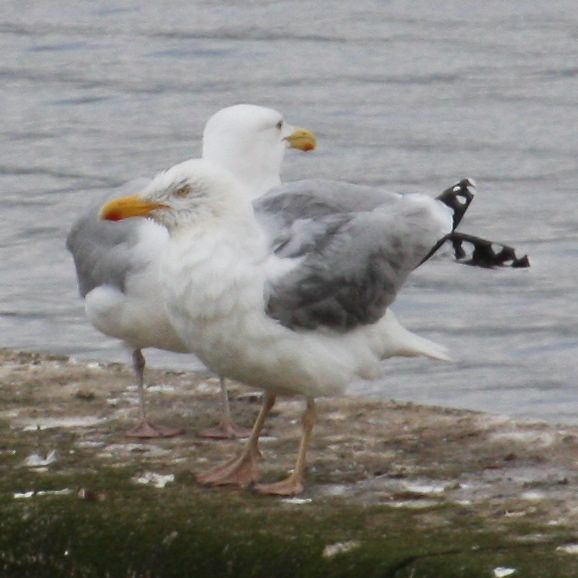
Well, that's what it looked like to me. Distinctly darker and duller grey than typical local argenteus Herring Gull, this bird looked like an argentatus from somewhere further North.

This first shot shows the upperpart tones of the 'argentatus' (top left), a Lesser Black-backed Gull (centre) and a typical argenteus Herring Gull (bottom right).


The following shot again shows the difference in the upperpart tone between the two Herring Gulls and a selection of Lesser Black-backed Gulls.

 Under and upperwing shots of this bird:

It is difficult to make out here, but P9 on each wing had a thayeri-type pattern.

Thursday, 19 May 2011

Hybrid Carrion x Hooded Crow again

Here is a hybrid Carrion x Hooded Crow photographed in Liberton recently. It is probably one of the two individuals seen over the last couple of years in the area. It appeared to be intent on picking small pieces of blossom from the gutter.


Also, who could resist the fantastic looks of a de-pigmented Carrion Crow for good measure?

Tuesday, 17 May 2011

Herring Gull with yellow(ish) legs at Alnwickhill

A very quick visit to Alnwickhill Water Treatment Works this evening unexpectedly produced a Herring Gull with yellow(ish) legs. Clearly not a Yellow-legged Gull based on structure, pale grey upper and black wingtip only extending to P6 rather than P5 or further. Yellow-legged Herring Gulls make up at least 50% of some populations in the Baltic, but they tend to be much less common among local argenteus Herring Gulls. It has been suggested that some dietary component can cause this brighter leg colour. In the first shot, can you guess which one it is?...