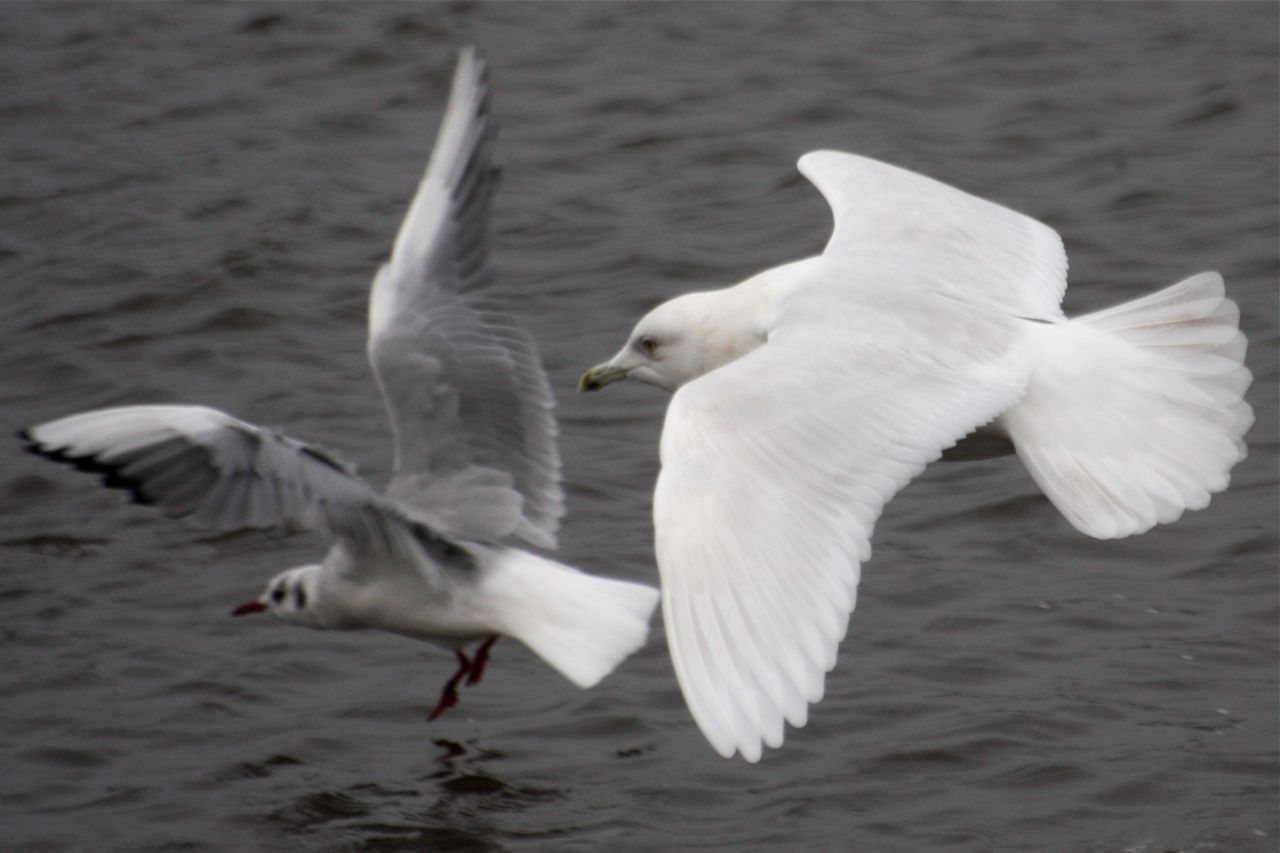
Still working through my collection of Iceland Gull photographs from the recent trip to Galway. The invasion is really concentrated in the Faroes and the Northern Isles. Hopefully I'll manage to find another in Lothian over the next few weeks...
Here is the first of the Iceland Gulls from one week ago. It was waiting for us on Nimmo's Pier and the whole family managed to see it without getting out of the car - which is just as well because they wouldn't have seen it otherwise! I saw it on three occasions over the next 24 hours and it was ther nearest to adult plumage that I saw on the trip - only a little brownish feathering on the breast and tail and the sub-adult bill pattern giving its age away. A very pale gull, it looked large and ghostly in flight.
Friday, 13 January 2012
Tuesday, 10 January 2012
It's a ringer: adult Ring-billed Gull in Galway
I bumped into Tom Cuffe while I was birding Nimmo's Pier on Saturday morning. We discussed the various white wingers and then I remarked that I was surprised that I hadn't connected with a Ring-billed Gull the previous afternoon. "Oh there is normally one down there", he said, pointing to some exposed rocks towards the mouth of the harbour. I trained my scope on the area and, sure enough, there it was! Cheers, Tom. We sauntered down and I gawped and threw some bread. For Tom, being local, a Ring-billed Gull barely warrants a second glance.
After looking at my photos I realised that I had also seen this bird before - in December 2010 (it is bird 2 in this post). Not only is the ring on the beak of similar width and shape and the head streaking very similar in density and distribution, but the shorter than normal tail feather (left T2) is identical. I had assumed that the uneven tail growth was some one-off feature in December 2010, but it seems to be consistent from year to year despite the fact that it should have moulted its tail at some point in the last 12 months... (cant find anything on this in Gulls of the Americas or Molt in North American Birds, but I haven't checked Gulls or BWP yet). Perhaps this feather is simply the last one to be replaced by this bird?
So here are some comparison shots of Dec 2010 on the left and Jan 2012 on the right:

So, no sign of any improvement in my photography in 12 months!
Here are a few more shots taken last Saturday. A great bird, in my opinion, and one I am keen to find locally. Might take a wee while in Lothian...
The following shots show details of wing-tip pattern and extent of head streaking.
Tuesday, 3 January 2012
Lesser Black-backed Gull 1/1/12 at Alnwickhill
This Lesser Black-backed Gull has been dropping in to Alnwickhill this winter so I was pleased to get it on my year list on the 1st. Increasingly seen in winter in Lothian, possibly as a result of climate change, this is the first one I have seen in winter locally.
The weather has certainly been extremely windy recently, another feature of climate change perhaps. I was cursing the strengthening wind yesterday as the vibration of my scope prevented a clear digiscope shot of this (Nowegian?) colour-ringed Common Gull. At least two colour-ringed Common Gulls were at the site yesterday (the rings were on different legs - does this mean ringed as an adult or pullus, I wonder?). Once again, no codes were read successfully - even after altering the levels etc below - the Common Gulls tend to roost at the far side of the site.
Monday, 2 January 2012
New species for Lothian predictions
The new competition on the block in Lothian is David K's guess-the-new-Lothian-species challenge. The following species have been taken in
the following order:
DK:
Pallid Harrier
Terek Sandpiper
Collared Flycatcher
IA:
Cattle Egret
Blyth's Pipit
Penduline Tit
DM:
Stilt Sandpiper
Ross's Gull
Whiskered Tern
DF:
Common Nighthawk
Chimney Swift
Isabelline Wheatear
MQ:
Fea's Petrel
Pallid Swift
Eastern Crowned Warbler
MT:
Greater Yellowlegs
Turkestan Shrike
Two-barred Crossbill
GM:
White-winged Scoter
Buff-bellied Pipit
Dartford Warbler
KG:
Eastern Olivaceous Warbler
Melodious Warbler
Eastern Bonelli's Warbler
LH:
Pacific Diver
Ancient Murrelet
Great Auk!
MH:
Oriental Turtle Dove
Siberian Stonechat
Dusky Thrush
CS:
Steller's Eider
Harlequin Duck
Bufflehead
PK:
Sooty Tern
American Robin
Southern Grey Shrike
JB:
Barrow's Goldeneye
Short-billed Dowitcher
Marmora's Warbler
After looking at this list I began to wonder which species have been recorded the most frequently in Scotland without being recorded in Lothian. Of course, the Northern Isles account for almost all of the records of some of the species concerned, and others are highly non-migratory, but an interesting list nevertheless. If it wasn't for the Isle of May and St Abb's mopping up so many of 'our' drift migrants, maybe we'd have seen a lot of these already...
Well, here goes, the most frequently recorded Scottish species unrecorded in Lothian: a list taken from the Lothian list on Bubo and a quick trawl through Birds in Scotland 3 (not guaranteed to be 100% accurate as more recent records will not be included...)- only those species with 10 or more records in BS3 included. Species in bold not selected above.
Crested Tit
Ptarmigan
Yellow-breasted Bunting
Siberian Stonechat
Lanceolated Warbler
Two-barred Crossbill
Pechora Pipit
Aquatic Warbler
Melodious Warbler
Booted Warbler
Scops Owl
Pallas's Grasshopper Warbler
Pine Bunting
River Warbler
Collared Flycatcher
White-throated Sparrow
Red-breasted Goose
Black-eared Wheatear
Little Bustard
Steller's Eider
Yellow-billed Cuckoo
Cirl Bunting
Sardinian Warbler
Western Bonelli's Warbler
So I'm beginning to think that some of my guesses weren't too clever... though I did see these two today
Only kidding - but Buff-bellied Pipit and Dartford Warbler - what was I thinking, to say nothing of White-winged Scoter... ah well, let's hope for some great birding 2012 in Lothian.
Bubo listing Lothian 2011 and 2012
Well, the year has drawn to a close with the Iceland Gull at Alnwickhill being one of the highlights of 2011 for me. A small twitch even developed at the site last week, although I think that most visitors left disappointed as the gulls often do not stay put there for long. Nevertheless, two Iceland Gulls and three Mediterranean Gulls at Alnwickhill this year have given me tremendous satisfaction. It shouldn't be that much of a surprise, I suppose, since Alnwickhill has a much larger area of water than St Margaret's Loch. My main target species at the site for 2011, Yellow-legged Gull, has sadly been conspicuous by its absence. Since the site will soon be drained, there is not much time left...
My own Lothian list ended up a mid-table 165, which was far below the figure I had hoped for at the beginning of the year, but 2011 has been extremely successful in a variety of non-birding ways, so I am not really complaining. The best months for listing in Lothian in 2011 for me were, rather predictably, January, May and October. The rest of the year saw a sprinkling of good birds with seven new additions to my county list: Mealy Redpoll (Jan), Bean Goose (Feb), Osprey (April), Temminck's Stint (June), Quail (June), White-rumped Sandpiper (Oct) and Richard's Pipit (Oct). Bird of the year for me in Lothian was the Grey-headed Wagtail in May.
Thanks to all the other Lothian Bubo listers of 2011 for making this year the biggest field yet. As with last year, Mike H is the one to beat.
So for 2012, I'll be keeping a Bubo list once again and I hope that others will do the same. My personal target for 2012 is 174 and a self-found list of over 160, which would better my 2010 totals. My birding will be restricted to termly holidays most probably, but I will manage some trips to the Western and Northern Isles as well as some travel further afield later in the year. I am hoping to move my World list on a little higher than the 2 species gained in 2011 (White-billed Diver, Indian Silverbill)...
Thursday, 29 December 2011
Leucistic Common Gull at Alnwickhill
Well I thought that I was going to draw a blank at Alnwickhill today. The highlights had been a pair of Goldeneye, the 5 Canada Geese just over the wall (pic below) and the unprecedented sighting of another birder at the site (nice to meet you Billy). Even the latter didn't seem to be enough to tempt any white-winged gulls into view. Or was it? As I got ready to leave, I had one last scan and this is what I saw in among a small group of Common Gulls.
Through binoculars the paler mantle and apparently abraded coverts reminded me of a Ring-billed Gull similar to this one (right) photographed in California in April 2010.
Through the scope it was clear that the wing coverts of today's bird were not abraded but simply lacking in pigment. This leucism was presumably responsible for the paler mantle shade. So, a partially leucistic Common Gull - not unheard of, but certainly not common. After a short time bathing this rather unusual looking leucistic gull took off and joined the stream of gulls heading for the coast during the late afternoon.

Through binoculars the paler mantle and apparently abraded coverts reminded me of a Ring-billed Gull similar to this one (right) photographed in California in April 2010. Through the scope it was clear that the wing coverts of today's bird were not abraded but simply lacking in pigment. This leucism was presumably responsible for the paler mantle shade. So, a partially leucistic Common Gull - not unheard of, but certainly not common. After a short time bathing this rather unusual looking leucistic gull took off and joined the stream of gulls heading for the coast during the late afternoon.

Wednesday, 28 December 2011
Iceland Gull returns to Alnwickhill
I had given up on the 1st winter Iceland Gull returning to Alnwickhill, but it was there again today at lunchtime. A quick visit coincided with some very unpleasant weather and I was in two minds whether to bother getting out of the car. I'm glad I did as the Iceland Gull was one of the few birds on the filter beds and it did not seem in the least perturbed by the conditions. It generally sat tight in comparison to the Herring Gulls which were arriving to bathe. Once again the coarse markings of the Iceland Gull were apparent. Head-on, in particular, it could be the darkest gull in the group.
I thought the weather was about to improve...
... but no...
Sadly, the weather beat me eventually - look at that spray! Iceland Gull in foreground
I was hoping that it was going to fly around a little, but a single wing-flap was all it managed... Think I'll pop back later when the rain has stopped...
Argentatus Herring Gulls at Alnwickhill
It has all been happening at Alnwickhill over the festive period. The lack of workmen on site has tempted back a flock of 90 Lapwing along with a variety of wildfowl including Canada Geese, Mute Swans and 7 Goosander. After a couple of days of gales, when the best I could manage was a colour-ringed Herring Gull (green-white-green on right leg - maybe from a Glasgow project?), today's calm conditions brought the gulls down in droves to bathe. A very brief visit this morning gave views of a 2CY Common Gull with dark markings on the tail and tertials - an uncommon plumage type that I don't think I have seen before.
This afternoon I had a little more time and was treated to squadrons of Herring Gulls dropping in to bathe in the nearest pool - not something they do very often and I think it is possibly related to wind direction. In amongst these I managed to pick out a couple of individuals showing the thayeri pattern on P9 as well as a couple of darker individuals with much white in the primaries - presumably northern argentatus Herring Gulls. In addition there were plenty of Common Gulls and Black-headed Gulls, as well as single Great Black-backed and Lesser Black-backed Gulls.
Biggest puzzler was the following bird which resembled a hybrid Herring Gull x Lesser Black-backed Gull but on reflection must be a subadult northern argentatus Herring Gull. One difficulty with its identification is that these northern Herring Gulls normally have a restricted amount of black in the primaries but this bird has black markings extending to P5. Of course this may be normal for birds of this age. It may, of course, be a darker than normal southern argentatus.
Obviously it is the upper bird in the first photo, which shows a pale mantled argenteus Herring Gull in front. The second picture shows the spread wingtip pattern.
The underwing can be seen in the shot below and this is followed by another shot of the bird on the water bathing with a Herring Gull.
Finally, some shots of the bird perched with argenteus Herring Gulls. Notice that the contrast between them and the argentatus appears less. In the last shot the difference between the two gulls does seem to be appropriate for northern argentatus and local argenteus.
Thanks to feedback from Stephen W and Andy (tittletattler) on BirdForum on this bird.
Here are some other pictures taken at Alnwickhill today:
Lesser Black-backed Gull (note the Black-headed Gull advancing into breeding plumage in the foreground - not the full hood it looks like from this angle but half-way there)

adult northern argentatus Herring Gull (much white on wingtips and darker upper parts than bird to its right)
thayeri-pattern Herring Gulls - two different individuals both with thayeri pattern on P9 (not quite visible in upperwing shot)
Lapwing

Goosander (left of centre) and preening Great Black-backed Gull (far right, honest!)
Grey Heron, Mute Swans and Canada Geese
Not a bad haul for Alnwickhill!
This afternoon I had a little more time and was treated to squadrons of Herring Gulls dropping in to bathe in the nearest pool - not something they do very often and I think it is possibly related to wind direction. In amongst these I managed to pick out a couple of individuals showing the thayeri pattern on P9 as well as a couple of darker individuals with much white in the primaries - presumably northern argentatus Herring Gulls. In addition there were plenty of Common Gulls and Black-headed Gulls, as well as single Great Black-backed and Lesser Black-backed Gulls.
Biggest puzzler was the following bird which resembled a hybrid Herring Gull x Lesser Black-backed Gull but on reflection must be a subadult northern argentatus Herring Gull. One difficulty with its identification is that these northern Herring Gulls normally have a restricted amount of black in the primaries but this bird has black markings extending to P5. Of course this may be normal for birds of this age. It may, of course, be a darker than normal southern argentatus.
Obviously it is the upper bird in the first photo, which shows a pale mantled argenteus Herring Gull in front. The second picture shows the spread wingtip pattern.
The underwing can be seen in the shot below and this is followed by another shot of the bird on the water bathing with a Herring Gull.
Finally, some shots of the bird perched with argenteus Herring Gulls. Notice that the contrast between them and the argentatus appears less. In the last shot the difference between the two gulls does seem to be appropriate for northern argentatus and local argenteus.
Thanks to feedback from Stephen W and Andy (tittletattler) on BirdForum on this bird.
Here are some other pictures taken at Alnwickhill today:
Lesser Black-backed Gull (note the Black-headed Gull advancing into breeding plumage in the foreground - not the full hood it looks like from this angle but half-way there)

adult northern argentatus Herring Gull (much white on wingtips and darker upper parts than bird to its right)
thayeri-pattern Herring Gulls - two different individuals both with thayeri pattern on P9 (not quite visible in upperwing shot)

Goosander (left of centre) and preening Great Black-backed Gull (far right, honest!)
Grey Heron, Mute Swans and Canada Geese
Not a bad haul for Alnwickhill!
Saturday, 24 December 2011
White Christmas: adult Med Gull at Alnwickhill
Another quick trip up to Alnwickhill pays off with an unringed adult winter Mediterranean Gull dropping in to bathe and loaf around with around 100 Black-headed Gulls. Fantastically white winged in flight, the Med Gull has to rank as one of my favourite species; watching it float around in the blustery wind after bathing was particularly enjoyable - particularly as this was the trip to try out the Opticron HDF eyepiece with the Kowa TSN4 scope body. A stunning optical improvement just in time for a stunning gull.
Other Alnwickhill news is that the 5 Canada Geese and 1 hybrid Canada x Greylag Goose have been replaced overnight by 7 Greylag Geese!
Subscribe to:
Posts (Atom)