Tuesday, 28 May 2013

Dark Pomarine Skua (with spoons)


While I was on Westray last week phenomenal numbers of Long-tailed Skuas were passing by in the NW gale. Seawatching in those conditions is not the recommended activity for a party of non-birding teenagers so despite walking the headlands in some outlandish May weather I was unable to watch the long-tailed sea-sprites pass by. Instead I contented myself with a single melanistic (dark morph) Pomarine Skua from the Westray to Kirkwall ferry. Well, I was pretty excited about this at least. No pics of the Basking Shark seen briefly on the same journey unfortunately.


Monday, 27 May 2013

Blue Fulmar in the Pentland Firth


I have been lucky enough to be visiting various of the Orkney islands for the past fortnight. Always a fantastic archipelago - packed with outstanding wildlife, archaeology and scenery - the weather was not the kindest this year and as it was a work visit I was unable to make the most of the birding on offer. For example I missed out on the phenomenal passage of Long-tailed Skuas last week despite being on Westray at the time... not to mention the Garganeys, White-billed Diver, Red-backed Shrikes, etc. Next time?...


Here is my best sighting of the fortnight - a blue Fulmar - an intermediate/dark morph of our Northern Fulmar. Only my fourth sighting of this form, I was pleased to get these record shots as the bird passed the ferry back to mainland Scotland, especially since I failed to get any shots of a probable at Seafield earlier this year.


Monday, 6 May 2013

Willow Warbler, Chiffchaff and Wood Warbler in Edinburgh

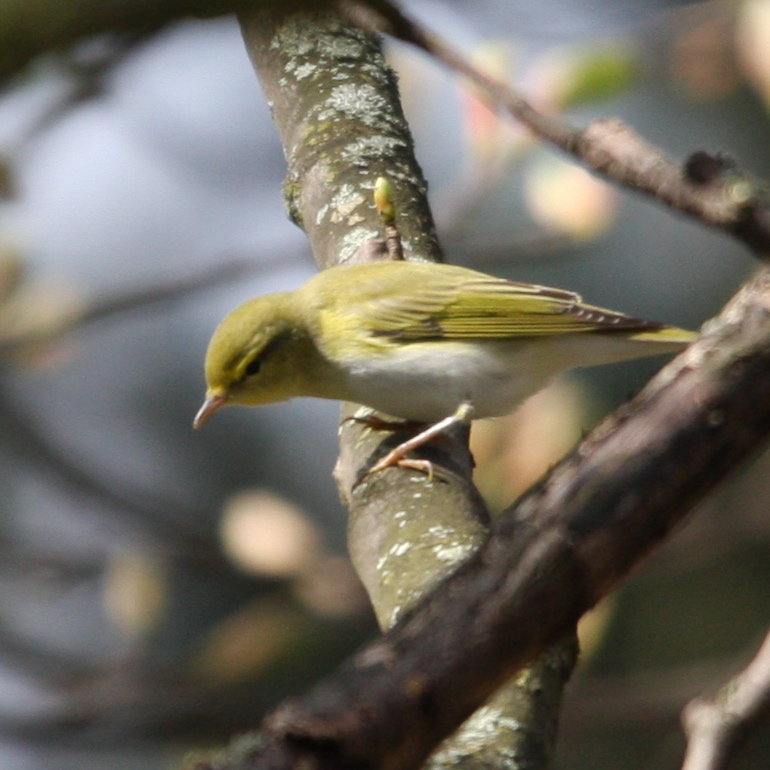
Wood Warbler giving shiver-song in Duddingston yesterday

I have managed to photograph these three species of Phylloscopus (leaf-searching) warbler in Edinburgh over the last few days. Of course, the Willow Warbler and Chiffchaff are common in the wooded and scrubby parts of the city at this time of year. Yesterday's Wood Warbler was a little more unexpected. Singing birds are no problem to identify - as Gilbert White famously noted in describing the three species as Laughing Willow-wren, Chif-chaf and Shivering Wilow-wren.

Yesterday's Wood Warbler showing off its primary projection and yellow throat
A Willow Warbler at Duddingston yesterday had the pale washed out appearance of a more northerly bird. Long primary projection obscured...
Note short primary projection compared to tertial length on this Chiffchaff photographed at Blackford Pond
Pale eye ring, dusky cheek and (in life) tail dipping behaviour all good Chiffchaff features


Sunday, 5 May 2013

Wood Warbler at Duddingston


I grew up in North Wales listening to the song of Wood Warblers through my bedroom window. After moving to Edinburgh I am pretty sure that I heard them singing in Blackford Glen and Craiglockhart Hill nearly 20 years ago and I have bumped into one or two on the East coast during migration periods. But when I came to compile my Lothian self-found list a couple of years ago I found that I could not recall the finding any particular individual Wood Warbler. So that species remained unchecked... until today.

The Wood Warbler, of course, has suffered a considerable decline in that time. It no longer sings in many woods that previously held them in Wales, and the situation is no different in Scotland. Today's bird, heard singing for an hour in Duddingston, will be passing through to some forest further North and West for it no longer breeds in Lothian.

A very beautiful species, with a real tropical look or that of a New World wood warbler, perhaps...


Isabel: dilution mutant Herring Gull at Seafield again

I spent a couple of hours checking the gulls at Seafield today. While it was the Lesser Black-backed Gulls that predominated on St Margaret's Loch en route, at Seafield it was almost entirely Herring Gulls at the recycling centre. The isabel dilution mutant was the clear highlight in among the latter. It showed on three occasions and posed well on the ground as well as in flight. Very nice, thank you - I had hoped for better views and was not disappointed.


Interesting that it appears to already have dropped a couple of innermost primaries. Could this early moult may be a result of the fragility of the unpigmented feathers?


Wednesday, 1 May 2013

Malawi Wagtails


Watching the wagtails along the coast at the weekend reminded me that there still are plenty of Malawi bird shots that I have yet to blog. Wagtails are always entertaining birds and these two species, African Pied Wagtail and the Mountain Wagtail are also strikingly attractive birds. Essentially the ecological equivalent of the Pied and Grey Wagtails south of the Sahara, I photographed the African Pied Wagtail on the shores of Lake Malawi and the Mountain Wagtail on a stream on Mount Mulanje.


Monday, 29 April 2013

White Wagtail rump shots, Scoughall, East Lothian


I nipped along the coast on Sunday morning hoping to catch some of the recent White Wagtail passage, and I was not disappointed. At least 20 birds were feeding on the uppershore. Not all were confirmed White Wags and there were a few definite black-backed Pied Wagtails in there, but this White Wagtail in particular cooperated for some definitive rump shots. The pale grey rump only has black tips on the longest feathers. If only all were this straightforward. Of course, even without seeing the rump on this this individual it is a pretty unmistakeable continental alba White rather than british yarrellii Pied. Other nice migrants on the beach were Whimbrel, Wheatear and half a dozen Willow Warblers working along the edge of the sea buckthorn.

Migrant Wheatear (left) and Whimbrel (right) on beach at Scoughall

Saturday, 27 April 2013

2 hybrid Herring x Lesser Black-backed Gulls at Seafield, Edinburgh


Both Herring x Lesser Black-backed Gull hybrids* were in among the gulls at Seafield today. Though it took quite a number of hours before the sub-adult (above) appeared on one of the factory roofs. This bird has a particularly broad band on P5, which would be a pro-YLG characteristic. As a sub-adult though we might expect a little more black on the wing of the hybrid as well. Through the scope the dark eye and dark marks on the primary coverts were clear - the latter are obscured in these shots, although the third (blurry) iphone-scope pic shows the width of the band.

*I am assuming that these two birds are both hybrids, rather than Yellow-legged Gulls...


Here are some shots of the adult bird from today. Seen on rooftops and in flight.


Monday, 22 April 2013

Introducing Isabel - a dilution mutation Herring Gull at Seafield

Herring Gull (centre) with dilution mutation (isabel) showing much reduced eumelanin across plumage
Seeing a white-winged gull is usually the highlight of any day's birding for me. Sunday was no exception and this time the bird was a Herring Gull, albeit one with a dilution mutation (as defined by van Grouw in the January edition of British Birds). This mutation results in a quantitative reduction of melanin - and since gulls only have one form of melanin (eumelanin) it is impossible to say whether this mutation is "pastel" (the reduction in both forms of melanin) or "isabel" (the reduction of eumelanin only).

At rest most of the plumage appeared to be snow white. Bare part colouration appeared to be normal.
This gull - let's call her Isabel, perhaps - has been reported at Seafield already this winter, but this is the first time I have seen her. Why her? Well, many of these conditions are sex-linked in birds, and since in birds the heterogametic sex is females rather than males (unlike mammals, where males only have one copy of the X chromosome), so I am guessing that it might be more likely that this bird is a female.
Massive crop, but gives a good idea of the bird in the field
I'm looking forward to closer views of Isabel at some point in the future... Here are some more flight shots - the normal grey upperparts are white and the black wingtip a nice faded grey.
The dark smudge on the underwing in this shot is a shadow of another gull.
Again, a shadow is unhelpful but the white plumage with grey on P8-10

Sunday, 21 April 2013

Adult Herring x LBBG hybrid* at Seafield again

Adult presumed hybrid Herring x LBBG. Same bird as seen 16 Feb, still present at Seafield today 21 April.

*All references to hybrid status are presumed based on phenotypic characters

Seafield again - grilling the gulls. I was hoping to get another look at yesterday's sub-adult Herring x LBBG hybrid but instead connected with the adult bird seen at the same site on 16 February. Interesting to see that this bird is still around. I managed four sightings in flight and on factory roofs. Each time it landed it was obscured. Each time it flew it was possible to track it given its mantle shade in between LBBG and Herring but given the number of gulls around at the recycling centre it was easy to lose in the throng.

Compared with yesterday's bird it has a longer grey tongue on the inner web of P10 and a band of uneven width on P5 - narrower on the inner web.
Once again, very fortunate to get any shots of it at all.

Check out those grey flight feathers...