Showing posts with label Carrion Crow. Show all posts

Tuesday, 9 April 2013

Phone-binning Crows at Bull Island, Dublin

No DSLR camera or scope today, just me, my bins, my phone and some crows. I was at North Bull, Dublin, and was taking the opportunity to look at some birds that we don't see so commonly around Edinburgh - namely black-tailed godwit, pale-bellied Brent geese and hooded crows. I also managed my first summer migrant landbird of the year - a nice male wheatear.

So here are some phone-binned pics of interesting crows. Well, interesting to me that is !

Hooded Crow
First winter Rook (x2)
Hybrid crow closely resembling Carrion Crow
Hooded Crow (x2)


Sunday, 20 January 2013

Foot It in Edinburgh: 76 miles without a Collared Dove

Hit the 100% mark on Saturday during a 14-miler. Started at around 8:00 am - nice and calm with fresh snow underfoot. One of the hybrid Hooded x Carrion Crows from last weekend was on the same rooftop so I fired off some better record shots. As I did so a passerine flew over silently - almost certainly a Meadow Pipit - galling that it wasn't calling as it would have been a Foot It tick...
The now customary hybrid along with a more regular Carrion Crow
All I could think was "flush a Bittern"! One of 3 Fox sightings on Saturday.
Into Craiglockhart Castle Park for nice views of Great Spotted Woodpecker and Kestrel, and then on to Duddingston where I tried in vain to will a Bittern to emerge from the reedbed. Only ever seen 2 here but... A Fox trotting along the edge of the ice and as it could do no better than me I decided to head around to view the open water. A single Pink-footed Goose in amongst the Greylags was unexpected - nice close views, so presumably feral, but could just be lost and disorientated and tagging along with the Greylags?

Pink-footed Goose on Duddingston Loch - feral or wild?
My first Foot It tick of the day - a GBBG in the middle of the ice
Scanning the gulls on the frozen loch I noted a single Great Black-backed Gull (species 72 after my mid-week Little Grebe). After drawing a blank on this species until now, I ended up with 3 sightings before the end of the weekend. As I was watching the gull some calls overhead revealed 2 Skylark heading towards the coast. Soon after 2 Meadow Pipits (73) passed over calling making up for the earlier dip. Satisfied that two glaring holes in my list had been plugged, I decided to go and twitch something unexpected and headed up Arthur's Seat to look for the Snow Buntings that had been reported earlier in the week. After an hour or so combing the various tops I conceded defeat and headed to check the wildfowl on St Margaret's Loch. Nothing new to add here but an impressive concentration of hungry birds and a few handfuls of birdseed were soon hoovered up.

Hungry Mute Swans on St Margaret's Loch
Heading for the Figgy I bumped into yet another hybrid Hooded x Carrion Crow, my sixth while Footing It and my ninth different bird in Edinburgh this winter. There are obviously a few around...
My sixth different hybrid Hooded x Carrion Crow whilst Footing It - this one at Mount Castle

At Figgate Park I was glad to see that my two target species were still on the pond and so Gadwall (74) and Shoveler (75) brought me up to 100% of my target. That said, I have walked a bit further than I initially planned to and roamed a little further afield so maybe my target of 75 was too low. In fact, there are three species that I have yet to see on my initial list (Collared Dove, Tawny Owl, Lesser Redpoll). Yes you read that right - 76 miles without a Collared Dove!
One of four Gadwall on Figgate Pond
 I know of three other species that have been reported in the area so far during the month (Crossbill, Fulmar, Snow Bunting). In addition, the following are possible, though unlikely perhaps: Grey Partridge, Bittern, Mediterranean Gull, Long-eared Owl, Green Woodpecker, Nuthatch and Mealy Redpoll. With one weekend remaining I don't see myself adding much more than Tawny Owl and Lesser Redpoll, but who knows?...
I hit 100% of 75 species with this handsome drake Shoveler

Sunday, 6 January 2013

Foot It Day 2: More hybrid crows

Spent the morning and early afternoon Footing It by following the Braid Burn downstream rather than upstream. Immediate success in the form of Grey Heron (species 50) and Grey Wagtail (51), with 3 or 4 of the latter. Another two Dippers added excitement along the river.

Grey Wagtail in the Braid Burn at Cameron Toll shopping centre car park. No Pied Wagtails yet though...

Into Inch Park and another hybrid Hooded x Carrion Crow had me thinking that this was a different bird to either of yesterday's. Then a pair of Stock Doves put on a nice show of bowing and strutting and posed for photos - this species normally seems to be very shy - maybe with the nice weather they were thinking about other things.

Stock Dove posing in Inch Park

At Duddingston Loch, Teal, Goldeneye, Canada Goose and Cormorant provided easy pickings but the unexpected absence of Little Grebe stalled me temporarily on 55 species. I scanned the margins repeatedly and wished that I had shouldered my scope but instead accepted a salmon-pink fly-by Goosander (56) as compensation. With Raven (57) and Great Spotted Woodpecker (58) also appearing at this site I returned home. No new species to come I did see Sparrowhawk number three and hybrid Hooded x Carrion Crow number four in Craigmillar.

My fourth Foot It hybrid Hooded x Carrion Crow - how many until I can tick Hoodie!...

While I always keep an eye out for these hybrids to see 4 in 2 days is a little surprising. I think that I have now seen enough Hooded Crow genes while Footing It to make a whole - just unfortunately not all in the same individual bird!

So with 58 species already recorded (89% of original target of 65), I have decided to revise my target upwards by adding all of my possibles to my probables to my new target of 75...

Saturday, 5 January 2013

First day of Foot It

Being away for New Year I had been vicariously enjoying the Foot It blog but frustrated not to be able to join in until today. So, feeling that I was playing catch-up, I set off from home this morning at first light and was glad that the weather was calm. The common corvids, gulls and finches started appearing as I headed into the Hermitage of Braid and with over 20 species by 9:00am I started to relax. I was glad to get both winter thrushes early as I hadn't noticed many of either species around this year. The first real goodie was a Water Rail streaking away like some sort of two-legged rat deep into a thick tangled patch upstream of Howe Dean bridge. I have only seen this species in this area on three previous occasions and was delighted to see it on my first attempt this year. A Dipper zipped past - it is regular here and is always a pleasure to see.

Next a couple of stake-outs. Tower Farm area for Tree Sparrow but not the 'dead-cert' Yellowhammers. Back home to check the back garden feeder for Brambling, which obliged - fortunate that one of the ones that arrived in December is still hanging on to the free hand-outs. A male Sparrowhawk then put in an appearance and flushed the finch flock so I was glad to have headed home when I did.

After a restorative coffee I was quickly back out and back up towards Alnwickhill. Yellowhammers put in an appearance and the Stock Doves were in their usual fields around Mortonhall. Mistle Thrush and Treecreeper were handy additions in this area as they have taken a few days in the past to find them around here in January. A bite to eat at Klondyke and Linnets and Reed Buntings were in their usual areas at Broomhills and Liberton Kennels. The fields did not yield partridges or snipe despite a couple of hours of effort - snow, please... Best bird in this area was a smart hybrid Crow and then another different bird a few fields away an hour later.

Hybrid Hooded x Carrion Crow at Alnwickhill, 5 Jan 2013
Second hybrid Hooded x Carrion Crow, Tower Farm, 5 Jan 2013

Only dip of the day was a skein of grey geese that I didn't get on to quickly enough, so I had to content myself with some Greylags and other assorted wildfowl at Blackford Pond. Before heading back home over Blackford Hill. Highlight here was my fourth raptor of the day - a nice Peregrine Falcon flypast.

So, since the hybrid doesn't really add a 0.5 the tally ended up at 49 which is 75% of my target. Not bad for a 9 mile walk... More tomorrow hopefully.


Tuesday, 24 April 2012

Carrion Crow vs Shore Crab: fight, fight, fight!

If you have ever wondered who would win in a fight between a Carrion Crow and a Shore Crab then here is your answer. Unsurprisingly, it is the intelligent, adaptable, avian predator-scavenger that comes out on top.


Photographed at Barns Ness in East Lothian last Sunday morning, this crow carefully manipulated this female crab onto its back and then twisted its tail off. After swallowing the tail the crow continued foraging, leaving the hapless crab to scuttle off, possibly mortally wounded.


I was left wondering whether the crab would survive, whether the crow had been hoping for an egg-mass under the crab's tail, whether the handling costs of dealing with the rest of this meal were just too high for the crow, or whether this behaviour would benefit the crow by eliminating a competitor from its patch.


Reaching for Birds of the Western Palearctic I find that crabs are not even listed as a food source for the Carrion Crow - the only Crustacea mentioned are woodlice and crayfish. Presumably there were no published studies of the diet of shoreline crows, as I am sure crabs would feature regularly. Certainly having been fortunate enough to have been working on BWP at the time Volume VIII was written and I can certainly vouch for the thoroughness of the research.

Saturday, 21 January 2012

Hybrid Crow at Burdiehouse

Spent an hour at Burdiehouse today looking through the flocks of corvids, pigeons, finches and buntings that are currently feeding in the stubble. A great concentration of granivorous birds, and one that must be bringing in more raptors than the single Sparrowhawk I managed.

Highlight for me was this hybrid Carrion x Hooded Crow as it was by far the most 'Hooded' individual that I have seen in the area. The features that distinguish it from a pure Hoodie are the black feathers in the vent, scapulars, rump and axillaries. Certainly this bird is much closer to the Hooded Crow end of the spectrum than Carrion Crow!


Sunday, 4 December 2011

Unsuccessful predation of Common Redshank by Crow

I watched this Carrion Crow swoop onto a Common Redshank in the shallows of the River Esk mouth at Musselburgh this morning. After a brief struggle the wader escaped leaving these feathers behind. Undeterred, this and other Crows continued to try to surprise waders although there were no further captures witnessed.


I managed another Snow Bunting, this time along the sea wall. There have been two along here recently. This bird, with its clean breast and pale looking rump is probably of the Scandinavian subspecies.


Other highlights included a nice white-winged Mediterranean Gull on the scrape. This area is possibly destined to becoming designated a Local Nature Reserve. This would be excellent news. If so, I wondered whether the vandalised sea-watching shelters and hide bench will be repaired, and noted that the water is low in some of the scrapes as the pump is out of action. I have no idea whether that is due to vandalism. Certainly there seems to have been repeated abuse of the facilities at this site over the years. The destruction of the sea-watching shelters does not look like typical vandalism to me - more like an act of deliberate and thorough destruction. Of course there is more to worry about than the destruction of visitor facilities perhaps. I was particularly frustrated today to see the unnecessary flushing of waders, wildfowl and gulls today by dogs... grrr. Grrrr, indeed!


Thursday, 20 October 2011

Gorgeous Geese

I realise that this is really letting the side down, but I'm a birder based in Scotland and have never really got into wild goose watching. I have tried. I have sat on the bench at Aberlady at both dawn and dusk to watch the departure and arrival of the Pink-footed Geese. I have watched White-fonts and Barnacles, Brents and Beans. Two years ago to the day I spent a week on Islay with the family hoping that the magic of the barnies would enthuse not only me, but also G and the kids. Well it didn't really work out that way, so I just had to make do with ticking this cracking Cackling Goose in amongst the Barnacle Geese instead (on the assumption it is a genuine trans-Atlantic vagrant)...


On the other hand, I do quite like grilling the feral flocks of geese that are knocking around Edinburgh, checking for oddities. This week I bumped into this odd rufous-tinged Canada Goose.


I had already seen pictures of this bird on Stephen W's blog so was not too surprised to find it at Musselburgh. The unusual coloration of this bird could be the result of staining or some genetic variant. Personally, I was hoping this bird would match some of the interior forms of Canada Goose, such as Todd's, but having had a good trawl of the net I realise that this is not the case. Instead I am now swayed towards Stephen's original diagnosis, which is that the bird is showing staining. This red-brown iron oxide staining is well-known and fairly common in some forms of waterfowl such as swans and snow geese, but is apparently uncommon in Canada Geese - certainly I cannot find any individual with as extensive staining as this bird. Here is an example showing limited staining of the cheek patch, for example.

The earliest reference to an analysis of this staining dates back to 1918 (Ferruginous stains on waterfowl by Frederic Kennard Auk Vol. 35, No. 2). This study, by Kennard, concluded that red-brown staining in wildfowl was the result of iron oxide deposition on the feather surface as a result of digging for food among mud and decayed vegetation. It also noted that Canada Geese were much less likely to be stained than Snow Geese due to their differing feeding habits. (Interestingly, this Canada Goose was the only one observed feeding in amongst the Pink-feet by Stephen...) More recently the staining in Snow Geese has been shown to correlate with summer breeding and feeding origin. If this Canada is showing staining, then I wonder what its summer home is - maybe somewhere up the River Esk, which is pretty rich in iron oxide in places.


There were three other oddities in the flock at Musselburgh - Greylag x Canada Goose hybrids. I managed pictures of two of these. The left hand bird in each photo - but what a rogues gallery these pics are - hybrid geese, feral geese, herring gull, feral pigeon - surely no-one is still reading! See also Stephen W's hybrid geese.


Finally, a real wild goose. A Pink-footed Goose photographed this morning at Musselburgh. Standing on its own at the breakwater, it looked lost and out of place. Some Carrion Crows seemed to think the same, and were giving it occasional tweaks to see if it could become an easy meal. Note that one of the crows had highly leucistic or depigmented wings - how refreshing after all those geese!

Thursday, 19 May 2011

Hybrid Carrion x Hooded Crow again

Here is a hybrid Carrion x Hooded Crow photographed in Liberton recently. It is probably one of the two individuals seen over the last couple of years in the area. It appeared to be intent on picking small pieces of blossom from the gutter.


Also, who could resist the fantastic looks of a de-pigmented Carrion Crow for good measure?

Friday, 4 March 2011

Esk mouth at Musselburgh

I managed a fleeting trip to the mouth of the River Esk at Musselburgh first thing yesterday morning. It is one of those sites where there is always something of interest to see.

As soon as I opened the car door a movement across the water caught my eye as a Kingfisher hovered briefly then dived for food. A quick record shot and then it was off, flying up a street rather than the river...
This nice year tick was soon followed by a flock of Twite and a smart male Reed Bunting. A quick scan of the seaduck and then I was off home again. Though not before grabbing a picture of the resident Carrion Crow x Hooded crow hybrid...

Thursday, 24 February 2011

Hybrid Carrion x Hooded Crow


This hybrid Carrion x Hooded Crow was also part of yesterday's flock but I only picked it up in flight and then it landed beyond the range of decent shots. I might pop back to the area in the next few days to see if I can get better shots, but since I have only seen this bird twice in the last three years I think there is a low chance of success. However, as it has predominantly Carrion Crow plumage it is probably not easy to pick up unless actively searching through the crows for something different.

Presumably this bird would be better described as a Carrion x hybrid as presumably it is a second generation hybrid.

White-winged crows

I managed a brisk walk around the Hermitage and Braids at lunchtime. Nothing beats patch birding really, even on days like today when the Dipper bombed off downstream as soon as I rounded the corner and the highlight was an all-too-brief view of a male Kestrel failing to catch a Chaffinch - maybe voles are proving scarce after the hard winter? As I passed a patch of scrub that I have checked repeatedly but unsuccessfully over the last few years for winter Redpolls and Bramblings, I grinned to myself, having seen both species already this morning from the comfort of my kitchen!

Once again, the area was finch-less, but never mind, on a patch there is always something of interest to watch.

Today it was a feeding flock of 70-80 Carrion Crows, which is a reasonably good size of flock for this species. These birds will probably be a loose association of birds without territories, and quite possibly would include a good proportion of 2nd calendar year birds.

Of these birds, I would estimate that somewhere between 5 and 10% showed clear signs of feather de-pigmentation (leucism) in their flight feathers. I am not sure whether this is a typical figure for this type of flock or whether the prevalence is higher at certain times of year or among birds of certain ages. Once I started looking it seemed that this flock contained an example of just about every pattern of feather de-pigmentation that I had seen in Carrion Crows before, from isolated asymmetrical patches, symetrical white flashes on parts of the wing, full broad white wing-bars through to almost fully white wings as in the bird shown above.


The next five pictures show five other birds from the same flock with different extents of de-pigmentation. Note that the bird shown above  also features in one of the the photos below, and the photo to the right also shows a more normally plumaged bird.


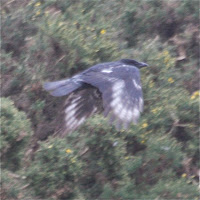


Finally, here is another Carrion Crow from the same flock. Most of the de-pigmentation on this bird is not visible when the bird is feeding.