Showing posts with label Jackdaw. Show all posts

Sunday, 15 September 2013

Not a Nordic Jackdaw?, Craigmillar, Edinburgh


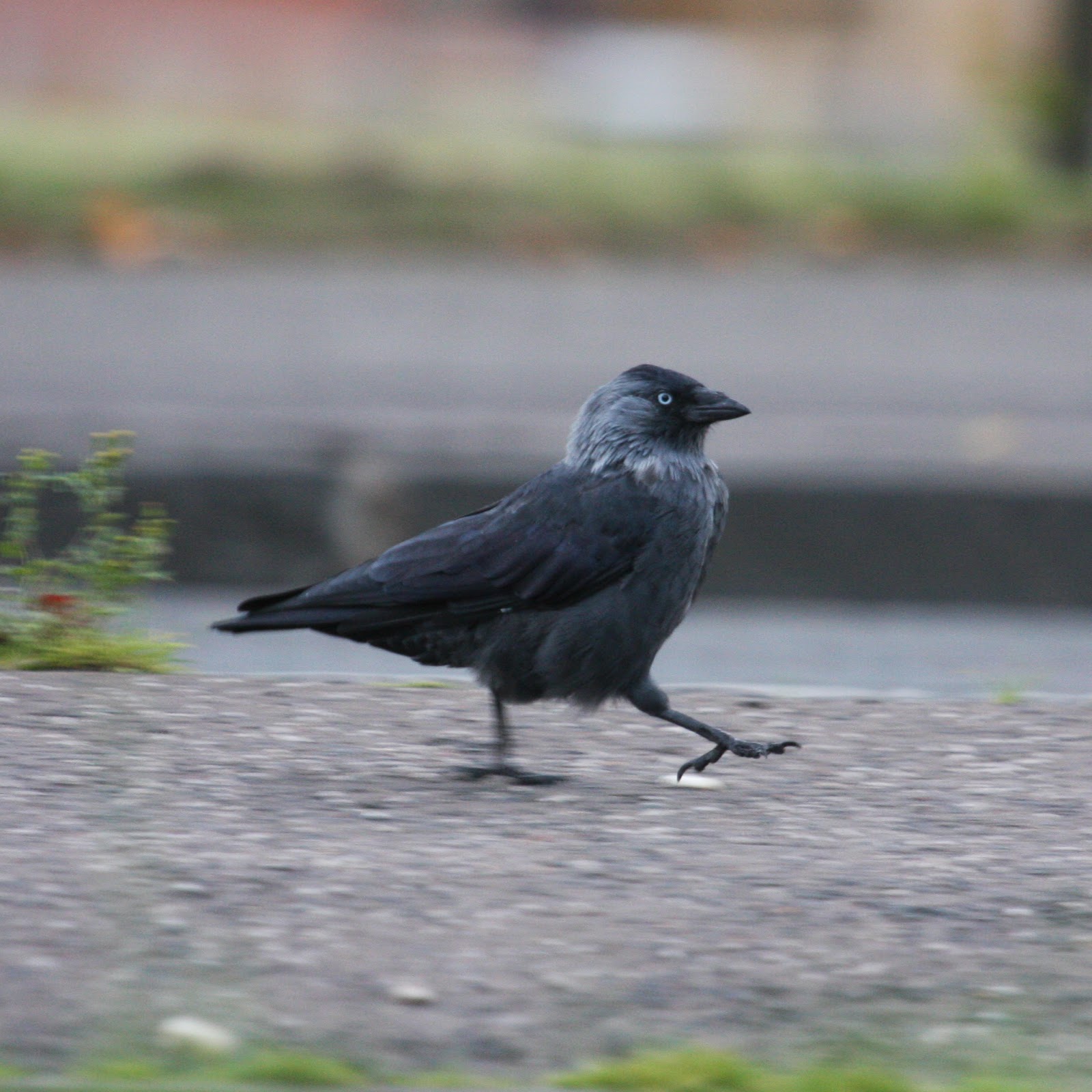
I have seen this Jackdaw several times in and around Craigmillar over the last year or so. When I first sighted it in November 2012 it had a clear pale half-collar and it seemed a reasonable assumption to consider it to be a Nordic Jackdaw. Over the year I saw it again briefly in March but have been surprised to see it in both August and September in the same area. What is more, it is clearly part of a pair.


These first three photos were taken yesterday. I suppose the question is whether this bird is Nordic Jackdaw (monedula subspecies) that has pair-bonded with a local bird or whether it is a male Western Jackdaw (spermologus subspecies) towards the edge of its variation...


Here is the same bird taken with my phone cam out of the car in August - clear headlights...


To try to get an idea of how common Jackdaws with pale neck collars are among our breeding birds I tried to get some shots of representative individuals earlier in the year. Most birds observed showed no collar or if they did so it was very dependent on the angle of illumination. On the other hand a small number of birds seemed to show faint collars. For example, here is a shot of a group of Jackdaws and a Magpie at Duddingston in May. The left hand bird, in particular, showed a faint collar at all angles both in life and in photos. I think that I am now less confident rather than more confident of any of my previous records of the C. monedula monedula in and around Edinburgh, and that any identification of Nordic Jackdaw be resticted to individuals with very pronounced collars along with the other identification criteria (e.g. contrast between wing and body plumage giving Hooded Crow effect).


Friday, 12 July 2013

New lens, old favourites

Young Jackdaw with 'brown' plumage mutation? One of two out of a hundred or so that were brown rather than black and grey
Took my new lens for a walk today. Was planning to buy it before I went to Malaysia, and while there were plenty of moments when it would have been handy, the thought of its first trip being into the haze of Sumatra was too much for me. So what did I test the L glass on - old favourites: corvids and gulls... Pretty pleased with the results...

Ah, one of my other old favourites - a lovely hooded Black-headed Gull
A juvenile Black-headed Gull - nice to see a couple of this year's young already on the wing

Monday, 28 January 2013

Last Foot It walk brings 2 pairs of partridges

Well, the weather forecast for Sunday was not good, but it was my only real chance for Footing It in this the last weekend of the competition. I dragged myself out of bed convinced I was heading out into the rain for a day where the only target met would be the mileage under the belt. As it turned out there were plenty of breaks both in the weather and the birding and I got three Foot It ticks, finishing the day on 79 species in 97 miles.

Waxwings - just the birds to revive spirits after 10 miles of Foot It...
I started the day experiencing exactly the same situation as Andy just blogged - a fly-over Redpoll that sounded more like a Mealy than a Lesser. I hung around for half an hour or so but it was not for returning... So, either way a Foot It tick but not countable on the views... Heavy rain almost had me turning on my heels after this disappointment but I spotted a loafing flock of gulls on a playing field up ahead and as I watched them padding for worms the skies lifted. Refreshed by a spot of gulling I set off along a stretch of river that has yet to ever provide a Kingfisher and today was no different.

I have walked miles along the burns and checked about a dozen Dippers - all chestnut bellied although this one is taking it to an extreme
But I was re-energised and decided to make a second Foot It ascent of Arthur's Seat in search of the Snow Buntings that had evaded me last weekend. Once again they had been reported mid week and once again they were to prove too elusive for the weekend watcher. It did not turn out to be a wasted journey with a pair of Grey Partridges (species 77) exploding out of a patch of gorse at my feet and disappearing in flight over a ridge. This was a definite bonus species as I had convinced myself that they were no longer present within my walking radius. The lack of buntings was no issue now as I felt I had made up for the redpoll failure.
Arthur's Seat - only have to ascend about 200m from my side - although it is 4 miles away from this part of my patch
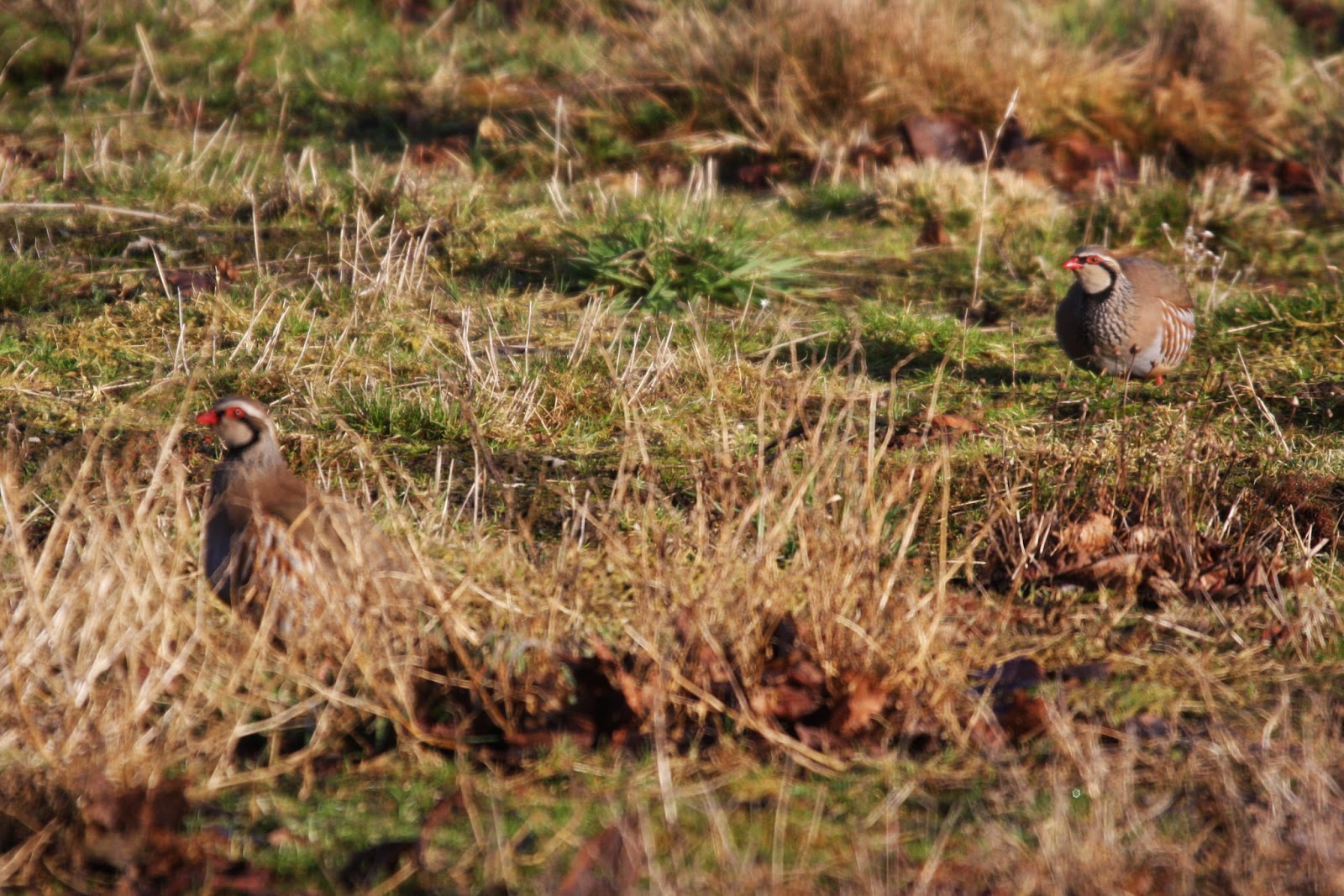
I turned and headed a few miles to my newly located gull loafing patch at Little France. In doing so I headed through a urban Craigmillar - an unlikely birding venue although the school pitch there had previously come up trumps with Curlew. This time I had just got beyond the housing when I noticed a movement in a weedy area of ground - a pair of nowhere-near-expected Red-legged Partridges (78). Local mega for me, with only one previous record in the area, and Foot It gold!

Red-letter Partridges - after Jack Snipe (and, err... Redshank) my top Foot It find
I spent an hour chilling (literally) with the gulls, but despite the weather could find nothing unusual. As I left Little France a small group of 4 Waxwings added to the mix. Actually, the first one I saw nearly gave me heart failure as it looked like a Hawfinch out of the corner of my eye. Now that really would be a good patch bird up here.

Waxwing doing Hawfinch impression - well that's what I thought it was out of the corner of my eye!
The Waxwings had done their trick and I felt that I should push on - the next tick might just be round the corner. Well, it was quite a few corners to be honest but at last, in Ellen's Glen, a single Collared Dove popped out of an ivy festooned hiding place and at last joined my last. So after 95 miles or so I finally grip back the Collared Dove to get me onto 79 species.

At last a bl**dy Collared Dove! Looks like this (young male?) is an autumn hatched bird as it still has some unmoulted coverts with pale tips. Maybe that's how it resisted the urge to disappear out of my patch for January...
Presumably that's my last addition, it looks like 75 was too low a target as I have added neither Redpoll, nor Kingfisher (which should be on my list since I managed to walk to the Figgate), I didn't see the Snow Buntings, Fulmars or Merlin reported on Arthur's Seat or the Crossbills reported over the Hermitage, or the Nuthatch that spent some of 2012 in the Hermitage or Green Woodpecker or Mediterranean Gull, both of which should be possible in theory. And with the slim possibility of Bittern at Duddingston then the list extends to 90 species. That of course would be a near impossible target, but I think 80 will be my starting target for 2014!

Post-Foot It? Well back to the corvids and gulls for me... now, is that a nordic jackdaw?

Sunday, 4 November 2012

Grey-headed Gulls, Malawi


I popped down to Seafield this morning to reacquaint myself with the Lothian avifauna. Nice views of Red-throated Divers were the highlight along with a colour-ringed Black-headed Gull (left yellow 2XCL - ringed in Aberdeen I suspect). [Also, just remembered, a candidate Nordic Jackdaw at the entrance to Craigmillar Castle along with a group of typical Jackdaws - I pulled in, avoided eye contact but the flock still flew before I got the shot...] As always at thecoast, I spent a wee while grilling the gulls - even a small number of Herring Gulls can provide plenty of entertainment for the larid-lover.

Gulls are not a major feature in Malawi. The only species that I saw was the Grey-headed Gull and I only had disappointingly brief and distant flight views. It is a species that I have seen before in Africa but never really within photographic range. Here are a few very poor record shots in flight.

The shots are of a first winter (if that means anything in the tropics) photographed on the Shire River at Liwonde National Park alongside a Whiskered Tern. The dusky underwings are fairly distinctive in the Grey-headed Gull along with the white blaze across the primaries and coverts

Finally, here is one of the Red-throated Divers from Seafield this morning.


Wednesday, 19 January 2011

Lothian ticks: Nordic Jackdaw and Mealy Redpoll

Took my sandwiches for a walk at the Braid Hills at lunchtime, since it was a nice day. Turned out to be a good decision.

Not only did I add fly-over Grey Wagtail, Collared Dove and 8 Stock Doves to my Lothian year list (about time for these three species!) but I managed to self-find a couple of Lothian life ticks.

Okay, so Nordic Jackdaw is not considered a full species, and I have probably seen it in Lothian already (see here for Lothian possibles and two more definite birds in Galway) - but it has been one of my target subspecies over this winter. The partial collars of both of these presumed monedula can be seen quite clearly here, although they did looked better in real life than in these cropped photos!


Note the 'headlamp' effect when this bird is viewed from the front. This was reminiscent of the Straiton carpark bird in March 2010. Quite possibly today's bird will look even more striking by March as feather wear is likely to enhance the pale collar.

The other Lothian tick was a Mealy Redpoll (right and below) at long, long last. Probably the biggest 'hole' in my county list (still plenty to fill...) - somehow previously I have avoided clapping eyes on a flammea Redpoll in Lothian. In past years most of my Redpoll sightings have been unidentified fly-over birds, or the breeding species, Lesser Redpoll.

With the current invasion of Mealy Redpolls into Britain, on the other hand, I was fairly confident that I could find one within easy walking distance of the house, and sure enough, today I found a small group of Redpolls in trees at the edge of the Braid Hills Golf Course. The first two I looked at were clearly Lesser Redpolls, as they were very brown with strong buff tips to their wing coverts.

The third bird was bigger, paler, with a longer tail and a lovely long primary projection crossing over the tail.

It then moved to another tree and showed nice pale tramlines, bold white covert bars and a strikingly white rump. This is as mealy a Mealy Redpoll as it is possible to get. It is so far along the scale that the potential confusion species is not cabaret Lesser Redpoll but instead exilipes Coues' Arctic Redpoll (see elsewhere on this blog for more about Redpolls).


Of course exilipes can be a difficult form to identify, but in this case the mantle and flank streaking of this bird is too strong and the structure of the bird is better for Mealy Redpoll. Note that the picture on the left gives an inaccurate impression of a small bill - in life the bird had a normal sized and shaped bill for a Mealy Redpoll.


The bird then dived into the centre of a large thick hawthorn and gave a brief view of its nice white rump feathers raised (just visible in picture on left) - a pretty good feature for exilipes perhaps, but in fairness just as good for a male flammea. And then it was gone. Redpolls are like that...

So, a great walk with some great birds. What could top that. Well another few de-pigmented Carrion Crows. Here's one in flight carrying, accidentally (I presume), a dead oak leaf.

Monday, 3 January 2011

Apparent Nordic Jackdaws in Edinburgh and Galway

My interest in the Nordic form (Corvus monedula monedula) of the Eurasian Jackdaw was rekindled in March 2010 when a bird with apparent 'headlamps' walked past my car in Straiton, Edinburgh. After fumbling with my mobile phone, I managed this poor photo of it disappearing into a fenced-off construction area before then taking flight. I returned with proper camera gear several times but did not see the bird again. I was disappointed as my only shot of the bird failed to show any of its distinctive headlamp-like neck collar, though the bird may be identifiable as the pale nape is apparent.

After reading up on the identification of this form, the following papers seemed to be most useful: Rudy Offereins Dutch Birding article and a translation of an Ornithomedia page. The conclusions tend to be that the most distinct birds are identifiable, but that various intergrade forms exist.

While these papers are useful at helping define the characteristics to look for in the field, a recent mtDNA analysis of the corvids by Haring et al (2007) gives us further food for thought about the degree of genetic separation of these different subspecies. While the study showed a clear split between the Jackdaw and Daurian Jackdaw as good species, there was no clear separation of the Western, Nordic and Eastern Eurasian Jackdaw subspecies lineages. This, of course, supports the field observations of intergrading between the populations.


This autumn and winter I have kept an eye out for possible Nordic birds. A passage bird on Fair Isle was too distant to be seen closely and most of the birds that I have seen around Edinburgh seem very shy or very clearly spermologus.

The following birds seen in the Hermitage in Edinburgh in late November may well be Nordic monedula or intergrades between the Western spermologus and monedula - an intermediate form that has been termed turrium. Unfortunately the views were too tantalisingly brief to be conclusive. In particular I could not be absolutely certain that I could make out the scaled underparts, a feature thought to be restricted to the Nordic form.


After so little success I was surprised to be treated to extended views at close range of birds with clear neck collars at Nimmo's Pier in Galway on 28 December. I was not expecting to see birds with these non-Western characteristics so far west in Europe! First a pair of birds on the Claddagh green fed close by before being spooked by a dog walker and then a single bird came to take bread from the slipway at dusk. These birds look like turrium type Nordic-Western intergrades perhaps? Perhaps I'll get another look at them in spring when they head back through the East of Scotland and back to Scandinavia...