Thursday, 24 February 2011
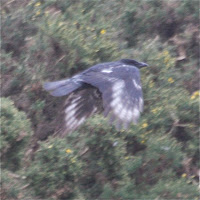
Hybrid Carrion x Hooded Crow
This hybrid Carrion x Hooded Crow was also part of yesterday's flock but I only picked it up in flight and then it landed beyond the range of decent shots. I might pop back to the area in the next few days to see if I can get better shots, but since I have only seen this bird twice in the last three years I think there is a low chance of success. However, as it has predominantly Carrion Crow plumage it is probably not easy to pick up unless actively searching through the crows for something different.
Presumably this bird would be better described as a Carrion x hybrid as presumably it is a second generation hybrid.
White-winged crows
I managed a brisk walk around the Hermitage and Braids at lunchtime. Nothing beats patch birding really, even on days like today when the Dipper bombed off downstream as soon as I rounded the corner and the highlight was an all-too-brief view of a male Kestrel failing to catch a Chaffinch - maybe voles are proving scarce after the hard winter? As I passed a patch of scrub that I have checked repeatedly but unsuccessfully over the last few years for winter Redpolls and Bramblings, I grinned to myself, having seen both species already this morning from the comfort of my kitchen!
Once again, the area was finch-less, but never mind, on a patch there is always something of interest to watch.
Today it was a feeding flock of 70-80 Carrion Crows, which is a reasonably good size of flock for this species. These birds will probably be a loose association of birds without territories, and quite possibly would include a good proportion of 2nd calendar year birds.
Of these birds, I would estimate that somewhere between 5 and 10% showed clear signs of feather de-pigmentation (leucism) in their flight feathers. I am not sure whether this is a typical figure for this type of flock or whether the prevalence is higher at certain times of year or among birds of certain ages. Once I started looking it seemed that this flock contained an example of just about every pattern of feather de-pigmentation that I had seen in Carrion Crows before, from isolated asymmetrical patches, symetrical white flashes on parts of the wing, full broad white wing-bars through to almost fully white wings as in the bird shown above.
The next five pictures show five other birds from the same flock with different extents of de-pigmentation. Note that the bird shown above also features in one of the the photos below, and the photo to the right also shows a more normally plumaged bird.


Finally, here is another Carrion Crow from the same flock. Most of the de-pigmentation on this bird is not visible when the bird is feeding.
Once again, the area was finch-less, but never mind, on a patch there is always something of interest to watch. Today it was a feeding flock of 70-80 Carrion Crows, which is a reasonably good size of flock for this species. These birds will probably be a loose association of birds without territories, and quite possibly would include a good proportion of 2nd calendar year birds.
Of these birds, I would estimate that somewhere between 5 and 10% showed clear signs of feather de-pigmentation (leucism) in their flight feathers. I am not sure whether this is a typical figure for this type of flock or whether the prevalence is higher at certain times of year or among birds of certain ages. Once I started looking it seemed that this flock contained an example of just about every pattern of feather de-pigmentation that I had seen in Carrion Crows before, from isolated asymmetrical patches, symetrical white flashes on parts of the wing, full broad white wing-bars through to almost fully white wings as in the bird shown above.
The next five pictures show five other birds from the same flock with different extents of de-pigmentation. Note that the bird shown above also features in one of the the photos below, and the photo to the right also shows a more normally plumaged bird.


Finally, here is another Carrion Crow from the same flock. Most of the de-pigmentation on this bird is not visible when the bird is feeding.
Wednesday, 23 February 2011
Iceland Gull revisited
A quick walk up Arthur's Seat yesterday lunchtime conveniently took in Dunsapie Loch for another look at its Arctic resident. According to BirdGuides, there were seven Iceland Gulls seen around the country yesterday but I am sure none of the others were quite as angelic as this one...
This is probably down to its new found aggressive feeding technique where it harries and harasses other smaller gulls until they drop their morsel for the Iceland Gull retrieve. A skua-like tactic that is clearly paying off.
Monday, 21 February 2011
Canada Goose x Greylag hybrid
Saw this hybrid Canada Goose x Greylag Goose at Dunsapie Loch today so I thought I would post the photos here. Looks similar, but maybe not identical, to a bird seen recently by SW (see Sedge Warbler blog). It seemed to be part of a definite pair with the Canada Goose in the picture, so maybe there will be some even odder-looking birds around next year. I suppose that could depend on how fertile this interspecific individual is...
"Imagine that, that bird's parents were two different species", I said to my youngest. In return I received a pitying look that said "I know the feeling..."
Labels:
Canada Goose,
Greylag Goose,
Hybrid
Sunday, 20 February 2011
Garden finches
The 'real birding' has yet again failed to materialise this weekend, so like the birds I have been foraging for scraps in the garden. Luckily the scraps were definitely worth feasting on – a nice healthy selection of finches at the feeders. The hide has been a very successful, if somewhat unconventional, piece of suburban garden furniture. I'm not quite sure what the neighbours think of it!...
First up, one of at least nine Bramblings that have been drawn in to the baited area. I hope that some of the males hang around for a few more weeks so that they have a chance to wear away those pale fringes to their head and mantle feathers.
After a very slow start, the niger feeder has been increasing in popularity. Only a single Goldfinch has visited as yet, but with at least three others in the area I am hoping it is only a matter of time before the whole charm descends.
Lesser Redpolls are the most frequent niger feeders. At least three have been on the feeder at any one time, with another six or so on the ground beneath. No sign this weekend of last week's Mealy Redpolls. They clearly do not realise that I set up the hide for them!
The Lesser Redpolls seem to be pretty regular now and one of the males has taken to singing from the birch tree. Not quite full song-flighting, but a good start for February. Here he sorting out his tail feathers in between bouts of singing. This undertail is at the pale end of the spectrum for this form, but Lesser Redpoll he is.
Another species that has been feeding in the garden this weekend is the Siskin. Just this individual so far, but with another dozen or so in the trees nearby, surely it is only a matter of time before there are swarms of them on the feeders.
Finally, the Chaffinch, a species that has kept a remarkably low profile this weekend. Here is male and female photographed yesterday by the youngest in the family - well done!
First up, one of at least nine Bramblings that have been drawn in to the baited area. I hope that some of the males hang around for a few more weeks so that they have a chance to wear away those pale fringes to their head and mantle feathers.
After a very slow start, the niger feeder has been increasing in popularity. Only a single Goldfinch has visited as yet, but with at least three others in the area I am hoping it is only a matter of time before the whole charm descends.
Lesser Redpolls are the most frequent niger feeders. At least three have been on the feeder at any one time, with another six or so on the ground beneath. No sign this weekend of last week's Mealy Redpolls. They clearly do not realise that I set up the hide for them!
The Lesser Redpolls seem to be pretty regular now and one of the males has taken to singing from the birch tree. Not quite full song-flighting, but a good start for February. Here he sorting out his tail feathers in between bouts of singing. This undertail is at the pale end of the spectrum for this form, but Lesser Redpoll he is.
Another species that has been feeding in the garden this weekend is the Siskin. Just this individual so far, but with another dozen or so in the trees nearby, surely it is only a matter of time before there are swarms of them on the feeders.
Finally, the Chaffinch, a species that has kept a remarkably low profile this weekend. Here is male and female photographed yesterday by the youngest in the family - well done!Friday, 18 February 2011
Not so redpoll
The garden has been alive with finches the last couple of days and at last the niger seed has brought the redpolls in. Most have been fairly typical Lesser Redpolls (if such a statement could ever be accurate...) and there have been a small number of Mealy Redpolls with four of the latter at any one time being the highest count. Currently, these two are considered separate species, so that is a garden tick (70 species!). I was pretty excited by the latter and dug out my old canvas hide. I don't think it has been assembled for 25 years, but dusted off it is doing the job. No unequivocal Mealy Redpoll rump-shots from it yet, but good shots of Lesser Redpolls and some also-rans.
According to BWP a redpoll with a yellow or orange, rather than red, cap is exceptional, although commoner in captivity. Well, I can't comment on how common this feature is but in a relatively small sample of redpolls (<20 birds) here are two showing this exceptional head colouration! The first is a paler bird, almost flammea like in its plumage with a distinctly yellow cap. The second bird, more typically cabaret has an orange cap. Both birds were seen in direct comparison with others with more normal red or deep pink caps. Any comments?
Edit: according to the Worcester ID paper, these caps are not uncommon on first year or female redpolls.


According to BWP a redpoll with a yellow or orange, rather than red, cap is exceptional, although commoner in captivity. Well, I can't comment on how common this feature is but in a relatively small sample of redpolls (<20 birds) here are two showing this exceptional head colouration! The first is a paler bird, almost flammea like in its plumage with a distinctly yellow cap. The second bird, more typically cabaret has an orange cap. Both birds were seen in direct comparison with others with more normal red or deep pink caps. Any comments?
Edit: according to the Worcester ID paper, these caps are not uncommon on first year or female redpolls.

Here is a screen grab of a Mealy Redpoll on the niger feeder with a Lesser Redpoll. Not a great shot, but it is a digiscoped shot through double glazing - presumably you can see why I dug the hide out!

Tuesday, 15 February 2011
Purps
I have had my nose well and truly to the grindstone with heavy work commitments for the last week and little chance to look out of the window. Changed that today with a half term day out with the family. We were going to climb the Pentland Hills, but with a low cloud cover in the morning they didn't look particularly inviting, so we headed coastwards for a wee jaunt up Berwick Law and a bit of a potter down North Berwick's High Street.
Not a birding trip, but great fun and good views from the summit. Nontheless, did manage three Waxwings at the centre of the Tranent roundabout as we came off the A1 and en route managed to spy a Raven and a Peregrine bombing over.
North Berwick shore is, of course, a reliable site for Purple Sandpiper on the rocks below the Seabird Centre, so I couldn't leave without a wee squint in their direction. Here are three of them with a couple of Ruddy Turnstone. The birds in this area seem to be fairly habituated and within a few seconds of me sitting on the rocks the Common Redshanks were soon feeding away close by. I didn't have long, but even a few minutes of watching these fantastic birds at close quarters felt refreshing...
Not a birding trip, but great fun and good views from the summit. Nontheless, did manage three Waxwings at the centre of the Tranent roundabout as we came off the A1 and en route managed to spy a Raven and a Peregrine bombing over.
North Berwick shore is, of course, a reliable site for Purple Sandpiper on the rocks below the Seabird Centre, so I couldn't leave without a wee squint in their direction. Here are three of them with a couple of Ruddy Turnstone. The birds in this area seem to be fairly habituated and within a few seconds of me sitting on the rocks the Common Redshanks were soon feeding away close by. I didn't have long, but even a few minutes of watching these fantastic birds at close quarters felt refreshing...
Thursday, 10 February 2011
Back garden raptors: Sparrowhawks
Thought I would post up a couple of shots taken late last August-early September of Sparrowhawks over the back garden. They probably go over and hunt through the garden every day, but nothing beats hanging out in the late summer sun waiting for one to go over. Of course, at that time of year the House Martins are around and their alarm calls herald the appearance of each and every hawk. The first picture is of a nicely coloured adult male. The fresh flight feathers and disorganised breast barring of the second bird indicate it is a juvenile, and its larger size indicates that it is a female.
Wednesday, 9 February 2011
Sparrowhawk disturbed at Magpie kill
I had to do the school run pick-up on foot this afternoon, so I popped my camera into my backpack just in case. As soon as I was out of the door it started spitting with rain, and as the leaden skies darkened I was regretting the extra weight.
As it turned out taking the DSLR was a good decision... I was cutting through a narrow lane when suddenly I heard an urgent rasping call. Right behind me there was a Sparrowhawk pinning a Magpie to the ground. For a few seconds the Magpie was twisting and fluttering to get free, all the time making the same distraught call. The Sparrowhawk was fully in control with one set of talons fixed to its prey's head and the other holding a wing. The hawk mantled its wings over its prey and then started to pluck the Magpie's breast and in a few moments the prey was quiet.

By now the Sparrowhawk had started plucking and I slowly crouched to try to get some steady shots in the poor light. I knew I only had a few minutes before I would have to continue on my way but I thought I would be able to get some record shots of the hawk starting to feed.
Unfortunately, at that moment another pedestrian appeared - arghhh... what terrible timing. What's more, they didn't seem very interested by the sight, in fact they were clearly revolted and just wanted to get past as quickly as possible. Given the narrowness of the lane, it was clear that this would flush the raptor and of course it did. The Sparrowhawk picked up its prey and headed off down the path although it was struggling to remain airborne.
Now I suppose that this hawk was unlucky that its prey did not fall either side of the walls running along this path, in which case it could probably have fed on a lawn undisturbed. On the other hand with the number of people constantly moving around a city like Edinburgh I cannot help but feel that this type of disturbance must be a commonplace and maybe daily event in the lives of our suburban birds.
From these shots, the bird looks to be in its 3rd calendar year. Its tail in particular has several brown retained juvenile feathers, the tips of which are showing severe abrasion. As for sex, the bird appears to be a female: the upperparts are not grey enough for a male; the cheeks show some rufous brown streaking rather than solid rufous; the supercilium is extensive above the eye; the barring on the breast is dark rather than rufous; the bird is bulkier than the Magpie.
As it turned out taking the DSLR was a good decision... I was cutting through a narrow lane when suddenly I heard an urgent rasping call. Right behind me there was a Sparrowhawk pinning a Magpie to the ground. For a few seconds the Magpie was twisting and fluttering to get free, all the time making the same distraught call. The Sparrowhawk was fully in control with one set of talons fixed to its prey's head and the other holding a wing. The hawk mantled its wings over its prey and then started to pluck the Magpie's breast and in a few moments the prey was quiet.

By now the Sparrowhawk had started plucking and I slowly crouched to try to get some steady shots in the poor light. I knew I only had a few minutes before I would have to continue on my way but I thought I would be able to get some record shots of the hawk starting to feed.
Unfortunately, at that moment another pedestrian appeared - arghhh... what terrible timing. What's more, they didn't seem very interested by the sight, in fact they were clearly revolted and just wanted to get past as quickly as possible. Given the narrowness of the lane, it was clear that this would flush the raptor and of course it did. The Sparrowhawk picked up its prey and headed off down the path although it was struggling to remain airborne.
Now I suppose that this hawk was unlucky that its prey did not fall either side of the walls running along this path, in which case it could probably have fed on a lawn undisturbed. On the other hand with the number of people constantly moving around a city like Edinburgh I cannot help but feel that this type of disturbance must be a commonplace and maybe daily event in the lives of our suburban birds.
From these shots, the bird looks to be in its 3rd calendar year. Its tail in particular has several brown retained juvenile feathers, the tips of which are showing severe abrasion. As for sex, the bird appears to be a female: the upperparts are not grey enough for a male; the cheeks show some rufous brown streaking rather than solid rufous; the supercilium is extensive above the eye; the barring on the breast is dark rather than rufous; the bird is bulkier than the Magpie.
Tuesday, 8 February 2011
Square-tailed armchair tick
Thanks to a comment made by BirdBoyBowey in a BirdForum thread, a previously unrealised tick came my way today in the form of a Square-tailed Nightjar (also known as Mozambique Nightjar) I photographed this bird in Imfolozi in South Africa in April 2007. I'd seen a few Fiery-necked Nightjars on the night drives but this one was the first to allow close-range photography - it seems that in my excitement I didn't bother to identify it! That said, the spotlight does make some of the bird's ID features a little more difficult to see, but surely that all white outer tail feather is unmissable!... Must do better next time...
Now off to a SOC talk by Ken Shaw - now he is not the type to make this sort of error, so I had better listen very closely...
Subscribe to:
Posts (Atom)