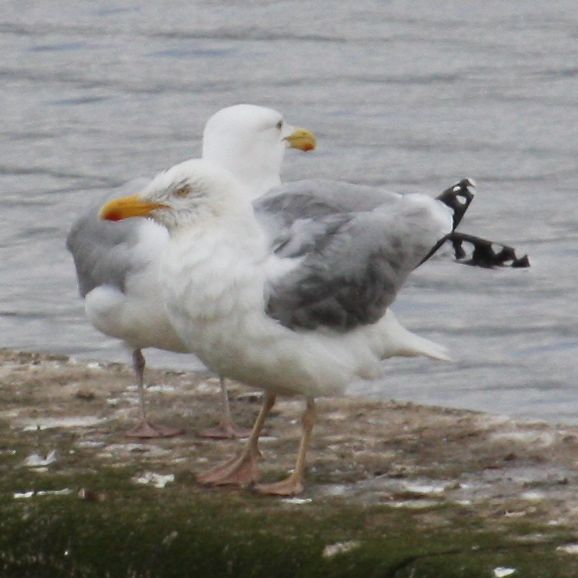
A very quick visit to Alnwickhill Water Treatment Works this evening unexpectedly produced a Herring Gull with yellow(ish) legs. Clearly not a Yellow-legged Gull based on structure, pale grey upper and black wingtip only extending to P6 rather than P5 or further. Yellow-legged Herring Gulls make up at least 50% of some populations in the Baltic, but they tend to be much less common among local argenteus Herring Gulls. It has been suggested that some dietary component can cause this brighter leg colour. In the first shot, can you guess which one it is?...
Tuesday, 17 May 2011
Monday, 16 May 2011
Odd herring gull: double thayeri on right wing
These Lesser Black-backed Gulls have never seen a Herring Gull looking like this before - well, at least I haven't! This Herring Gull seen at Alnwickhill during a brief visit today showed an extensive white tongue on the primary 9 reaching all the way to the white mirror at the tip (this is the thayeri pattern as it is the pattern shown typically by Thayer's Gulls). Very unusually, this bird repeats the pattern on P7, on its right wing at least. It also only had one leg, had a fairly pale yellow beak for an adult bird and appeared to have very oddly bulging central primaries (or maybe it has just moulted P1 and P2). Altogether a pretty unique looking bird!...


Sunday, 15 May 2011
Bateleur-a-like tail-less Common Buzzard
What a weird bird today over Mortonhall, Edinburgh - an almost completely tail-less Common Buzzard. Superficially Bateleur like in appearance but not really as exciting to watch... Nevertheless, not something I have seen before. I can only wonder what has caused this loss of tail feathers and hope that it is not a sign of persecution...
Friday, 13 May 2011
Herring Gull with thayeri wing pattern at Alnwickhill
A very brief visit up to the water treatment works at Alnwickhill yesterday produced this Herring Gull with a nice so-called thayeri type wing tip. That referes to the long white tongues running down the inner edges of the primaries and especially P9. This is a common wingtip pattern in Northern argentatus Herring Gulls though this bird appeared to be very much like the other local argenteus in all other respects - other than the iris speckling which gave a dark-eyed appearance to the bird. I photographed a similar bird in Dunbar in August of last year and there is a short thread in Gull-Research about that bird. Essentially I was interested to see whether this wing-tip pattern is found in argenteus Herring Gulls. The answer, based on research in Belguim and the Netherlands, appears to be that it is an uncommon pattern among pure argenteus and more common where intergrades between argenteus and argentatus occur. As for this bird, it could fit any of the above categories...


Tuesday, 10 May 2011
Balranald Buntings
A real birding highlight of a recent trip to North Uist was hearing Lapland Buntings singing for the first time. A group of at least 41 birds were hanging around the Balranald RSPB visitor centre and many of the males were getting into their striking summer plumage. It had been many years since I had last seen this plumage on a similar bird on my local patch in North Wales and I thoroughly enjoyed the close views of one particularly tame male who fed at the side of the path.
After feeding he hopped up onto the fence for a look-a-like pose with a bird that I had photographed on Fair Isle last autumn.
It was not just Lapland Buntings at Balranald. A smart male Reed Bunting was feeding along the strandline along with a wave of White Wagtails. This one shown here was singing at Barn's Ness this week.
Not all buntings area as visually striking - Balranald is also well known for its Corn Buntings, though we only managed to see this lone individual. He was singing as well, and I hope that a female has responded to help boost the precarious population of this disappearing species. As a breeding and resident species it is now apparently extinct in Lothian. I was lucky enough to see a single at Barn's Ness last autumn, which was only one of two records that I know of in the county last year.
After feeding he hopped up onto the fence for a look-a-like pose with a bird that I had photographed on Fair Isle last autumn.It was not just Lapland Buntings at Balranald. A smart male Reed Bunting was feeding along the strandline along with a wave of White Wagtails. This one shown here was singing at Barn's Ness this week.
Not all buntings area as visually striking - Balranald is also well known for its Corn Buntings, though we only managed to see this lone individual. He was singing as well, and I hope that a female has responded to help boost the precarious population of this disappearing species. As a breeding and resident species it is now apparently extinct in Lothian. I was lucky enough to see a single at Barn's Ness last autumn, which was only one of two records that I know of in the county last year.
Friday, 6 May 2011
Tree Pipit: patch tick
A quick walk around Alnwickhill this evening produced 4 Tufted Duck on the water works and male Kestrel carrying prey. That's fine, I thought, enough to keep me going until I get out birding later in the weekend. In the meantime I was idly marvelling at the reproductive capacity of rabbits as witnessed by the sudden appearance of a multitude of small bunnies hopping around in the fields, when I noted an odd wing movement in the distance. As if on cue, a Common Buzzard was trying to balance while pinning one of the aforementioned and now writhing bunnies to the top of a telegraph pole. Within moments a Carrion Crow was on the scene and the Buzzard headed off carrying its prey.
Last leg of the walk and I was hoping for a Grasshopper Warbler in a patch of scrub when a pipit flushes out of the edge of a grassy field. Silent, and just fractionally bulkier than the Meadow Pipits that were in the same area only a few weeks ago, its more direct flight immediately suggested Tree Pipit. Sure enough it headed for a nearby thick hedge where it showed a nice contrast between the heavier breast streaking and narrow flank streaking (just visible in this heavily cropped shot). It then flew again and I assumed it was gone, but instead it turned and headed back towards its original location and landed in among the gorse scrub.
A careful stalk gave me a good view as it sat up in a broom plant for a couple of minutes. Not the best angle for viewing perhaps, but from the photos it is probably possible to discern the narrow flank streaking, curved hind claw, supercilium behind the eye, pale cheek spot and slightly stouter bill of this species. There appears to have been a strong passage of Tree Pipits through Lothian this spring. As a breeding species the Tree Pipit seems unaccountably rare in the region. Even though this is the first individual I have seen at the patch, there is a good amount of what appears to be suitable habitat in the Alnwickhill, Braids and Hermitage areas of Edinburgh and as the species can be unobtrusive unless singing I would assume that this species is a regular migrant in the area.
Last leg of the walk and I was hoping for a Grasshopper Warbler in a patch of scrub when a pipit flushes out of the edge of a grassy field. Silent, and just fractionally bulkier than the Meadow Pipits that were in the same area only a few weeks ago, its more direct flight immediately suggested Tree Pipit. Sure enough it headed for a nearby thick hedge where it showed a nice contrast between the heavier breast streaking and narrow flank streaking (just visible in this heavily cropped shot). It then flew again and I assumed it was gone, but instead it turned and headed back towards its original location and landed in among the gorse scrub.A careful stalk gave me a good view as it sat up in a broom plant for a couple of minutes. Not the best angle for viewing perhaps, but from the photos it is probably possible to discern the narrow flank streaking, curved hind claw, supercilium behind the eye, pale cheek spot and slightly stouter bill of this species. There appears to have been a strong passage of Tree Pipits through Lothian this spring. As a breeding species the Tree Pipit seems unaccountably rare in the region. Even though this is the first individual I have seen at the patch, there is a good amount of what appears to be suitable habitat in the Alnwickhill, Braids and Hermitage areas of Edinburgh and as the species can be unobtrusive unless singing I would assume that this species is a regular migrant in the area.
Adult and juvenile Common Buzzard comparison
I am quite a fan of Common Buzzards and, like many folk these days, can see them from the garden most days of the week. This shot was taken last week and I have posted it as it shows a nice comparison of adult and juvenile structure.
In the picture above, the adult (above left) shows a nicely parallel wing shape, solid dark trailing edge to the flight feathers, evidence of moult in the flight feathers and a broadly based slightly shorter tail. The juvenile (lower right) has a narrower hand so a distinct S-shape to the trailing edge of the wing, no clear dark trailing edge to the wing feathers, no clear evidence of moult (i.e. all flight feathers of a similar age) and a narrower, longer tail. The juvenile has an altogether more harrier-like jizz in this picture.
Some of these details may be clearer in these cropped images. Once again the adult is shown above the juvenile.
These differences are less distinct when birds are moving away from the observer, as shown in this shot. The more distinct trailing edge of the flight feathers in the adult is still obvious in direct comparison.
Labels:
Common Buzzard,
Garden
Thursday, 5 May 2011
Fine views of Fair Isle Locustella
I popped into Blindwells, East Lothian, for the first time this evening. Just a quick 10 minute stroll but long enough to hear my first couple of reeling Grasshopper Warblers of the year. I must get out into the local patch over the next few days as this is a species that should be around, especially this year when so many seem to have been reported.
The last Grasshopper Warbler that I saw was on Fair Isle last October. It managed to briefly resemble both of its rarer relatives Lanceolated and Pallas's Grasshopper Warbler when it was seen initially, the former in this view which hides most of the bird's bulk, and the latter in flight as its tail was soaked so looked much darker than a Gropper's tail would normally. Ah well, I'll just have to find that pair on my local patch as well...
Here is a shot of the morphing warbler and a couple of other fine views of Fair Isle.
The last Grasshopper Warbler that I saw was on Fair Isle last October. It managed to briefly resemble both of its rarer relatives Lanceolated and Pallas's Grasshopper Warbler when it was seen initially, the former in this view which hides most of the bird's bulk, and the latter in flight as its tail was soaked so looked much darker than a Gropper's tail would normally. Ah well, I'll just have to find that pair on my local patch as well...
Here is a shot of the morphing warbler and a couple of other fine views of Fair Isle.
Monday, 2 May 2011
White-tailed Eagle flight shots
Regular readers of this blog (Hi, Mum, Stephen and Joseph!) will realise that I am particularly keen on raptors, so the recent trip to the Outer Hebrides had me twitching with excitement at the prospect of lots of sightings of all things hooky-beaked.
As we headed off along the Edinburgh bypass I was already over-enthusiastically pointing out Common Buzzards to the family. "You know, I have seen quite a few Buzzards already", was G's response. Fair enough, since they do pass over the garden every day, and I do have a slight tendency to point them out every single time... even when they are pretty high up...
"Yeah, well I just thought it would be a good idea to give you all a quick Buzzard refresher course since we are going to see lots of Eagles in the Outer Hebrides", I added, lamely trying to think up some logical explanation for my involuntary birder outbursts.
A few minutes later, it was G who broke the silence. "Well that one looks pretty big!" I had also seen it and was driving in a more slack-jawed manner, staring disbelievingly upwards through the windscreen. "It's an Eagle! An immature White-tailed Eagle!" We were barely off the ring-road and heading up the M9, but here above the motorway was one of the birds that we were traveling hundreds of miles to see. I craned my neck and then fleetingly made use of the glass roof - one of the reasons I bought the car was the idea that nice big birds up above would be visible. "Have you seen it?", I asked the kids. "Yes", they chorused, somehow managing to look up and keep Mario on track on their Nintendos.
Wow! Of course, it will be an individual from the wave of recent releases for the East coast reintroduction scheme... (not sure it would have been possible to see any wing-tags under the circumstances). Actually I don't think that matters much because it was really cool!
Here are a few shots, not of the Lothian bird, which funnily enough I did not photograph, but of birds seen in the Outer Hebrides as intended. First some shots of an adult, accompanied by some very irritated Shelduck.
Here are some shots of an immature - it has more bulging secondary feathers and a longer darker tail than the adult. Hopefully these shots get across some of the colossal feeling of this species.
Finally, to give a slightly better idea of scale, here is this immature White-tailed Eagle being mobbed by a Great Black-backed Gull.
As we headed off along the Edinburgh bypass I was already over-enthusiastically pointing out Common Buzzards to the family. "You know, I have seen quite a few Buzzards already", was G's response. Fair enough, since they do pass over the garden every day, and I do have a slight tendency to point them out every single time... even when they are pretty high up...
"Yeah, well I just thought it would be a good idea to give you all a quick Buzzard refresher course since we are going to see lots of Eagles in the Outer Hebrides", I added, lamely trying to think up some logical explanation for my involuntary birder outbursts.
A few minutes later, it was G who broke the silence. "Well that one looks pretty big!" I had also seen it and was driving in a more slack-jawed manner, staring disbelievingly upwards through the windscreen. "It's an Eagle! An immature White-tailed Eagle!" We were barely off the ring-road and heading up the M9, but here above the motorway was one of the birds that we were traveling hundreds of miles to see. I craned my neck and then fleetingly made use of the glass roof - one of the reasons I bought the car was the idea that nice big birds up above would be visible. "Have you seen it?", I asked the kids. "Yes", they chorused, somehow managing to look up and keep Mario on track on their Nintendos.
Wow! Of course, it will be an individual from the wave of recent releases for the East coast reintroduction scheme... (not sure it would have been possible to see any wing-tags under the circumstances). Actually I don't think that matters much because it was really cool!
Here are a few shots, not of the Lothian bird, which funnily enough I did not photograph, but of birds seen in the Outer Hebrides as intended. First some shots of an adult, accompanied by some very irritated Shelduck.
Here are some shots of an immature - it has more bulging secondary feathers and a longer darker tail than the adult. Hopefully these shots get across some of the colossal feeling of this species.
Finally, to give a slightly better idea of scale, here is this immature White-tailed Eagle being mobbed by a Great Black-backed Gull.
Sunday, 1 May 2011
April round-up: ticks all round
April seems to have flown by, which is exactly what most of the best birds I have seen this month have done. My Lothian yearlist has remained in the doldrums with an accumulated total of only 119 species, which is way off Mike H's 159 species and the combined total of 164 species recorded in the county so far this year on Bubo listing. However, I have had an excellent month bird wise with self-found patch-ticks in both Edinburgh (Osprey, plus second record of Merlin) and Nercwys Mountain (Hobby) as well as a self-found lifer in Highland (White-billed Diver). Plenty of other interesting birds were seen in the Outer Hebrides (divers, waders, raptors, buntings). Even if I did fail to connect with either the big white falcon or the big white owl, I did manage to find a big sandy hawker dragonfly while on North Uist - a Vagrant Emperor - more later.
The Hobby provided an interesting diversion shortly after the royal wedding on Friday as it raced over fairly high on a north easterly bearing. As I haven't managed much birding at my Welsh patch in recent years I decided to ask Peter R about its recent local status when I saw him later in the day. "Ahh... it's funny you should ask", he commented "I just saw one today during the royal wedding." Since Peter's sighting was in the next valley it is highly likely that we saw the same bird!
A quick walk this morning before heading back to Scotland up to the Bryn Alyn SSSI limestone pavement revealed a lovely showing of Early Purple Orchids including the magnificent specimen above.
Subscribe to:
Posts (Atom)