Wednesday, 11 September 2013
Barred Warbler records in Lothian
Here is a Google Map that I made after seeing last weekend's Barred Warbler at Barns Ness - a two-day bird as far as I know. It got me wondering about the number and distribution of Barred Warbler records in Lothian. As far as I know last weekend's bird at Barns Ness would be Lothian's 34th record - although there is an offshore record from 1991 (SOC trip aboard Gardyloo) and it has been sighted on Bass Rock at least twice, but I am unsure whether these count as Lothian?...
From the records I have details of there seems to be a real concentration in terms of time (Aug: 5; Sept: 10; Oct: 11; Nov: 1) and location - note 14 records at Barns Ness, 4 at Torness, 4 at Skateraw and 1 at Thorntonloch - a real hotspot for sure. Other records are 2 on the Bass and singles at Aberlady (2003), Musselburgh (2005), Oxwell Mains (1992), Easter Inch Moss (1997) and Edinburgh (1946).
What really surprised me by this distribution was the lack of records along the North Berwick coastline as far as Dunbar. Scoughall has certainly been reasonably well watched over the years - is it a lack of elder bushes in that area? Could Seacliff be an area that we are missing them?...
Monday, 9 September 2013
Pectoral Sandpipers in Lothian
| More of a Speck Sand than a Pec Sand - its the smaller wader on the left hand side of the group of three with the, err..., distinctive pectoral band... honest! |
Dave A has found another yankee wader at Musselburgh - an impressively regular happening. Today's bird is a juvenile Pectoral Sandpiper. I don't think you'll find any helpful features in the shots that I took of it roosting in among the Redshank at dusk! This is Lothian's most regular transatlantic wader and today's record is Lothian's twenty sixth. Records have been fairly widely spread although Musselburgh and Tynningham/Belhaven Bay account for over half of the records. More than half of the records have occurred since 2000 and this, no doubt, reflects increased observer awareness and improved optics. I'll be replacing my Kowa TSN4 shortly, which has given me many hours of active service, and I'm hoping that my new Meopta will boost my chances of adding this species to my feeble 'found' list...
Here is a chart showing arrival dates of new birds (black bars) and longer stayers (open bars). Note that each month is divided into thirds. The average length of stay recorded is 4 days, though 10 birds were recorded on only one date.
![]() |
July August September October November
|
All four July birds were adults and all records later in the year have been juveniles. All records that I can find on SOC and LBRC webpages are listed below.
Tynningham/Belhaven Bay: 7 records
(10 Sept 1961, 16–18 Sept 1983, 14–15 September 1999, 24–25 August 2005, 2–4 October 2005, 3–10 September 2006, 22 September 2011)
Musselburgh: 6 records of 7 birds
(4–5 September 1987, 19–20 September 1996, 15–23 July 2004 (2), 12–17 July 2007, 13 September 2010, 9– September 2013)
Aberlady: 2 records
(10 Aug 1948, 16 Oct 1954)
Gladhouse: 2 records
(19–28 September 1997, 16 October–9 November 2003)
Gosford: 1 record
(19 Nov 1955)
North Berwick: 1 record
(16 August–1 September 1974)
Cobbinshaw: 1 record
(11–14 October 1975)
Linlithgow: 1 record
(16 October 1977)
Bavelaw: 1 record
(10–12 September 2004)
Lochhill Flood, Spittal: 1 record
(25 September 2005)
Cramond: 1 record
(26 July 2009)
East Fenton Farm: 1 record
(19 September 2010)
Sunday, 8 September 2013
Ring-necked Ducks in Lothian
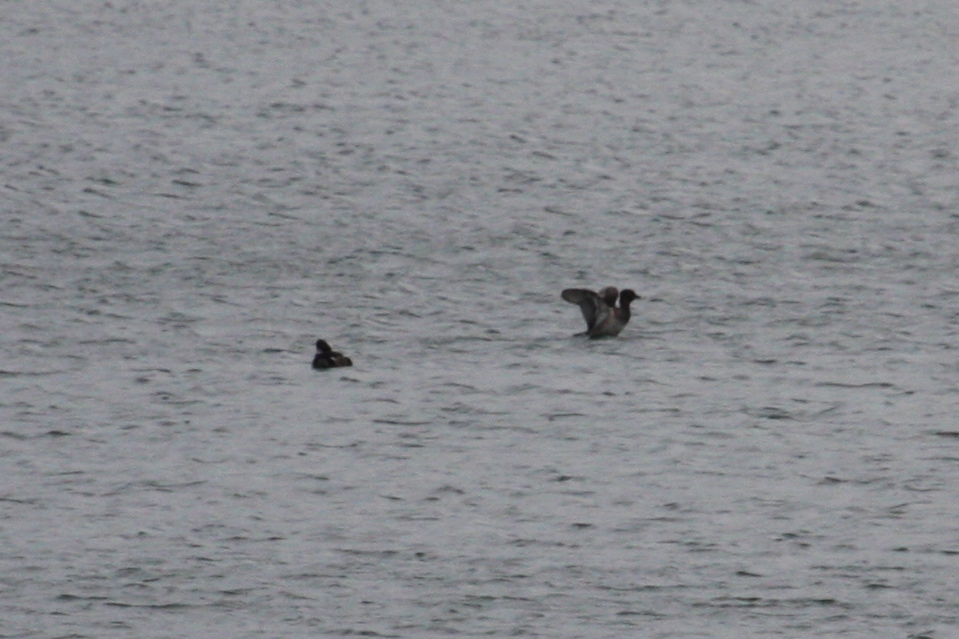
My most recent Lothian tick has been the moulting male Ring-necked Duck that has been hanging out in White Sands Quarry since it was found in late June. It took me two months to have a look given other commitments over the summer, but sure enough, if you are willing to look long and hard enough it can be picked out at distance among the flock of moulting Tufted Ducks. Almost as rare are the couple of Pochards that are also in the flock.
![]() |
| Extensive black area on vent and hind belly |
Viewing the lake is not easy. There are two options and both are distant. To get the best light try from the lay-by just past the turn off to White Sands bay beach car park in the morning. Towards the late afternoon try from the birding screen. Hopefully, if this site is developed for both birds and birders some sensitively designed viewing hides could be installed with concealed walkways to allow a closer approach...
| Grey wing-bar visible when wing flapping |
Whichever time of day many of the ducks will be either actively diving or roosting on the water or around the edge. The Ring-necked Duck is becoming more distinctive as the grey flanks and white wedges are beginning to become striking. The pale band across the bill is another feature that can be distinctive at distance. If the bird flaps its wings then the grey wing-bar is diagnostic. Finally, one subtle feature of the bird out of the water is the shape and extent of the black around the tail and vent area - just seemed more extensive black on the rear belly than a tuftie to me anyway.
This is only the eighth record of Ring-necked Duck in Lothian. With five of these since 2000 it certainly seems to be detected with increasing regularity. Initial sightings have been well spread through the year with Feb (2), March, April, May, June, July and October being the months that birds have been found. It seems that any large waterbody is worth checking with records from Linlithgow (2), Whiteadder, Seafield Pond, Gladhouse Res, Duddingston and Drem/East Fortune all having records.
Ring-necked Ducks in Lothian
22 June 2013– male, White Sands Quarry
12 October 2008 juv, Whiteadder
19–22 July 2008 male, Linlithgow
26–27 April 2006 male, Seafield Pond
12–16 May 2002 female, Gladhouse Reservoir
26 Feb–16 March 1989 male, Linlithgow
24 March 1982 male, Duddingston
6 Feb–9 May 1977 female, Drem and East Fortune
Saturday, 7 September 2013
Wire dump warblers
Tuesday, 13 August 2013
Juvenile sinensis Cormorant, Seafield Pond, Dunbar 13 Aug 2013
The sinensis Cormorant (the continental subspecies of our local Cormorant) was still considered a national rarity in Scotland until earlier this year. There have now been over 20 records of this subtle subspecies, most of which were seen in Lothian, including this bird that I found at Musselburgh in 2010. As a one-time description species I think it is now merely a notable subspecies at local level, though I don't think I'll get out of the habit of looking for them whenever Cormorants are near enough for scrutiny.
The identification hinges around the angle that the bare skin forms relative to the cutting edge of the mandibles. There are lots of diagrams on google, but this is a good one. In today's bird the angle was easily 90° which puts it safely in the sinensis camp. I think, though I am not an expert, that the bird can be aged as a fresh juvenile by the brownish plumage, pale tips to the coverts and generally unworn plumage.
Thursday, 8 August 2013
LBB x Herring Gull hybrid, Musselburgh, 8 Aug 2013
| Lesser Black-backed Gull, hybrid LBBxHerring Gull, Herring Gull (top–bottom) |
I popped along to Musselburgh mid-afternoon to check the gulls. Loafing among the gulls along the river was one of the hybrid LBB x Herring Gulls that I found earlier in the week. I managed a better mantle comparison shot for this bird (Bird 2) than I managed earlier in the week. The (feral/formerly injured) Pink-footed Goose was back in the area - I haven't seen it for quite a few months.
| Another mantle shade comparison but this time with a Common Gull with an apricot or rosy hue to its breast and underparts (centre). The hue is stronger in life than is captured by the camera. |
Also of note was the first juvenile Common Gull that I have seen this season. It was alongside some adults that were hidden in among the Kittiwakes at the roost. One of the adult Common Gulls had the apricot (or rosy) tint to its white plumage. This seems to be very unusual - I think it is only the third individual that I have seen with this tint in the last three years (for one bird see here and here). It could, of course, be that I have seen the same individual three times. I have photographed this plumage tint before - although it seems that (like the rosy tint in other small gulls) the human retina is better at seeing it than the digital sensor in a camera.
Monday, 5 August 2013
Two more Herring x LBB Gull hybrids - this time at Musselburgh
| Comparison shot showing different mantle tones of argenteus Herring Gull (left), graellsii Lesser Black-backed Gull (right) and Herring x LBBG hybrid (centre). This is Bird 1 of 2. |
Here is today's first bird a sub-adult advanced third summer type plumage, perhaps, or retarded fourth summer...
| Hybrid Herring x LBBG at Musselburgh 4 Aug 2013 (Bird 1): a view of the pattern of black on underside of primaries |
| Hybrid Herring x LBBG at Musselburgh 4 Aug 2013 (Bird 2): note mid grey upper tone and pinkish leg colour. Note band across P5 on nearest wing - narrow particularly on inner margin. Eye ring reddish. |
| Hybrid Herring x LBBG at Musselburgh 4 Aug 2013 (Bird 2): P6 is growing on left wing. Extensive black/brown in the tail and extensive brown secondaries. |
| Hybrid Herring x LBBG at Musselburgh 4 Aug 2013 (Bird 2): Not only is this bird almost identical to the one in Adriaens et al (2012) but it is almost identical to the one I photographed nearby in 2010 and was discussed in BirdForum here. |
Finally, here are both birds together, with a Herring Gull. As I was photographing the second bird the first flew up river and checked me out to see if there was any more croissant going!...
Saturday, 3 August 2013
Myna dip
| Crested Myna... sadly not.. |
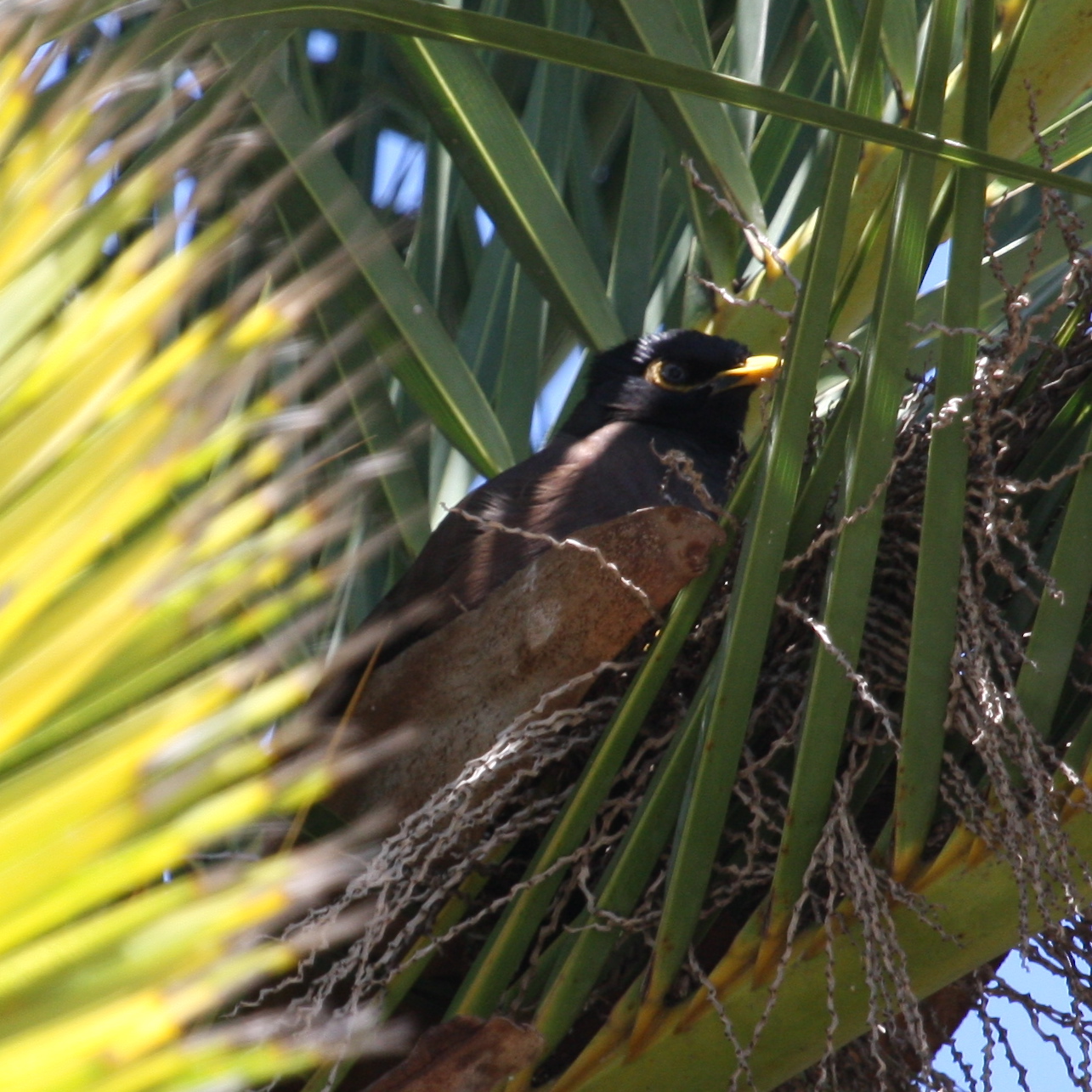
Too busy before my recent brief trip to Portugal to get to grips with the range of exotic species breeding in and around Lisbon, I was unaware until too late that there is an easy Crested Myna roost just across the Tejo estuary at Barreiro. Galling, especially since I had driven past the area at the right time of day. Ah well, can only blame myself for not doing my research thoroughly enough. Anyway, on last morning of the trip I decided to combine some gull photography along the Lisbon shoreline with a check of a few shoreline parks to see whether any of the mynas has make it across the water for the morning.
| Its a Common Myna |
| Singing away in Lisbon |
I'd seen a few species of mynas earlier in the month with Common Myna, White-vented Myna and Hill Myna regular species in Singapore and Malaysia.
| Common Myna in Malaysia earlier in the month |
| White-vented Myna in Singapore Botanic Gardens |
| Hill Myna on Pulau Tioman, Malaysia - big, noisy, but shy birds |
Friday, 2 August 2013
Mediterranean Gulls in Edinburgh and Lisbon
| Unringed adult Mediterranean Gull at Seafield, Edinburgh, 2 Aug 2013 |
| Today's Med Gull (centre) enjoying the delights of the Seafield shoreline |
| Juvenile Mediterranean Gull in Lisbon on 28 July 2013 - not a Portuguese breeding species as far as I know... I wonder how far this one has travelled since fledging... |
| First summer (2CY) Mediterranean Gull in Lisbon on 28 July 2012 |
| Mediterranean and Black-headed Gull comparison |
Thursday, 1 August 2013
Long-legged Buzzard/Gibraltar Buzzard? El Rocio, Donana, Spain 18 July 2013
The Atlas Long-legged Buzzard Buteo rufinus cirtensis is little known in terms of its identification and distribution. Not only is it similar is size and structure to the Common Buzzard but there are suggestions that the two forms hybridise. With photos of the quality of the first three here an identification is not safe but I'm going to stick my neck out and suggest that this adult bird that I photographed a couple of weeks ago at El Rocio in the Coto Donana is an Atlas Long-legged Buzzard. This ID is tentative but based on the apparent leg length in the perched shots, the tail pattern in the flight shot below and some of the plumage features of the underwing...
Since writing this post earlier today I have become aware that there is considered to be a possible Long-legged x Steppe (?) Buzzard hybrid swarm of buzzards known as the Gibraltar Buzzard that has recently been identified in southern Spain. Presumably this bird is one of these...
Whether this nearby juvenile has any Atlas Long-legged Buzzard genes in it I'm even less sure about...
Subscribe to:
Posts (Atom)