Wednesday, 19 October 2011

Musselburgh Pom and Med Gull

Bookended the day with a seawatch off Musselburgh morning and evening. Good numbers of gulls around, particularly Kittiwakes moving west in the evening. Stephen W watching further along the coast at Ferny Ness scored with a Sabine's Gull just after I headed for home - don't quite know whether or when it would have passed Musselburgh but it was one of the species that I was looking out for today.

My main targets were skuas and although I was pretty certain that I saw three species today, only a couple of Pomarine Skuas in the morning and a single Arctic in the evening were clinched. It might well have been a good day to be watching from Hound Point. It is a few years ago now, but I've had all four species from there in the space of a few hours.

Best bird of the day however goes to a winter adult Mediterranean Gull seen feeding among a group of Black-headed and Common Gulls. While Mediterranean Gulls are no longer unusual at Musselburgh, this is the first I have seen here this year and also the first that I have picked up in the scope while seawatching - normally I have seen them loafing or at most coasting. Hopefully it will be a more frequent sight as numbers continue to build year on year it seems. Not the plumage of today's bird, here is a pic taken in the South of France this summer.


Unlike this bird photographed on a hot summer evening in the Med, today's birding was decidedly Arctic, both in temperature and supporting cast - Long-tailed Duck, Goldeneye, Slavonian Grebe as well as the Velvet Scoters, Goosander and Red-breasted Mergansers... Brrr...


Monday, 17 October 2011

Bonus bonxie

A family walk this morning rather than a birding trip, but since the destination was Whitesands and Barns Ness it would have been churlish to leave the binos at home. We walked the coastal path and looked for fossils in the rocks - the limestone beds being particularly rich in corals and crinoids. A brief squint out to sea in magnificent light against darker skies revealed a Great Skua scything north against the wind. A nice gingery individual, I wondered whether it was a 1st year bird - either way it was my first sighting of the year. Not a bad haul over the last couple of days with Red-necked Grebe, Barnacle Goose, Ruff, Little Egret, Crossbill and Richard's Pipit all added to the Lothian yearlist already - certainly about time I did some catch-up after a few months without birding time. The best sighting of the day, however, was my lens hood sitting on the Brans Ness shingle where I must have dropped it two days before - what a find!

Here are some Great Skua pics from Orkney 2009. The first is a typical adult, the second a paler cap-less bird harassing a Gannet (three shots of the same bird) and the last a juvenile.


Sunday, 16 October 2011

Richard's Pipit the third

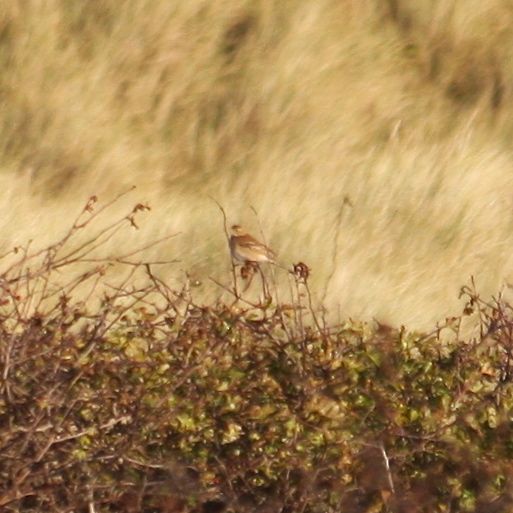
Ian A found a couple of Richard's Pipits in Aberlady dunes yesterday afternoon. After Ian's initial sightings the birds had been looked for by others but without success so it was looking like they had moved on. On the other hand there is a lot of habitat at Aberlady to hide a couple of Richard's Pipits so I decided to pay a visit this morning. There would be plenty of other birds around - maybe the Little Egrets that have been hanging around the bridge and certainly some of Stephen W's 9500 Pink-footed Geese...

After a couple of hours of very enjoyable birding I decide to head home having slowly worked around to the spot whether the pipits had been seen the day before. I turned around and almost immediately noticed an enormous pipit flying around and almost dwarfing some neighbouring Skylarks. It was only then that I realised that it was calling - a distinctive and repeated sparrow-like 'shreep' - a Richard's Pipit!


True to form it quickly disappeared, bounding rapidly through the air and off over several dunes. Obviously I decided to follow it and was surprised to flush it close by - at the time it did not occur to me that that was the second bird...

I continued, carefully skirting dunes to try to get a view of the area the bird(s) had disappeared into. Scanning ahead I noted a large long-legged passerine on top of a hawthorn bush and through the scope could see that it was a 1st winter Richard's Pipit - I hadn't been expecting to see it through the scope in this habitat.


The bird moved over another rise, so I followed carefully to find it atop another bush to be joined by not one but two others!


The three birds moved again, hovering and then landing at the edge of a marshy dune slack. I settled down with my scope to watch them preening and feeding. Soon only one bird was visible as the others had disappeared into the vegetation.

They seemed settled but then all three lifted yet again before landing in the next damp hollow. I shifted carefully and this time they flew over my head and then back around towards the path. By this time other birders were on the scene so I gave directions and we waited. No further sign before I had to leave although as we waited we heard a Richard's Pipit call - this time from an overflying bird - could that have been the fourth of the day?...


 So, a Lothian, Scottish and a Lothian-self-found tick to boot - not bad for a morning's stroll!

Saturday, 15 October 2011

Sunrise over Barns Ness Lighthouse

Headed out to the east coast before dawn arriving just in time to see this fantastic view of the sunrise over Barns Ness Lighthouse.

As I was travelling east along the A1, I had a good view of the cement factory 'windsock'. Sadly the plume was heading rapidly out to sea rather than in the other direction. Of course, an even better sign for grounded migrants is the plume heading westwards and also rendered invisible by low cloud and light rain...

Birdwise, I was pleased to stumble into another (or the same) Short-eared Owl a little bit further NW along the coast from yesterday's sighting. Today's bird rose up from rough grass and then gained height over the sea before drifting inland to allow the mobbing gulls to be replaced by corvids (fuzzy pic below...).


More exciting was a brief sparring encounter with a Peregrine. The latter then buzzed a curlew that was feeding on the shore before reappearing close by for a rapid flypast.


Migrants were few and far apart with a few small skeins of Pink-footed Geese, a total of 6 Lapland Buntings, 3 Redpoll sp., 5 Blackcap and a probable Yellow-browed Warbler which allowed a few silent glimpses as it flitted in the canopy. Fingers crossed that the wind heads east sometime soon...

Friday, 14 October 2011

Scandinavian Short-eared Owl

First day of my holiday and I managed a quick trip down to the coast after 4:00pm. By the time I got there the light was already beginning to fail but nevertheless I decided to check the bushes and bay at Skateraw. No obvious migrants around so I settled down to scope the gulls in the bay. I had just started working through them when suddenly they lifted in a dread. I was hoping for a skua or raptor (an Eleanora's falcon had been seen earlier in the week along the coast) and was delighted to find a Short-eared Owl working hard against the breeze heading toward the shore. A nice yeartick for me, its dark under wingtips and dark carpel patches above made separation from its longer-eared relative fairly straightforward. Fresh in from Scandinavia, no doubt, it crashed down onto the nearest bank of shingle and sat, looking nervously from side to side. I carefully slipped away to leave it to recover. Liuckily as it was getting dark, the constant stream of walkers, dog walkers and so on had ceased for the day.

Apparently it has been a great day for Asio owls along the east coast with up to 50 in off the sea at Titchwell in Norfolk. I think I'll pop back tomorrow for seconds.

Here is a Short-eared Owl, photographed in Orkney in 2009.


And here is a Long-eared Owl from closer to home... hmm.. one of my better photos?...

Sunday, 2 October 2011

Dip, drip and tick

Dave A found yet another rare along the East Lothian coast on Friday - an adult White-rumped Sandpiper at Musselburgh. I thought that I had no chance of seeing it but I managed to squeeze a quick trip down to the lagoons on Saturday afternoon to find that it had flown off, presumably to feed on the sands.

Spurred on by the disappointment of dipping I got up early this morning and managed another quick trip to Musselburgh before attending a meeting in central Edinburgh for the day. Despite the pouring rain, the White-rumped Sandpiper was feeding with Dunlin and a single Curlew Sandpiper. The light was terrible, the optics were steamy, and time was very short. Still glad I made the effort as this American vagrant was a Lothian and Scottish tick for me!


White-rumped Sandpiper (right of centre) with Dunlin in pouring rain and heavy cloud - so much for the heatwave!

Sunday, 25 September 2011

White p6 on Black-headed Gull

Had a weekend working in Stirling while others are seeing all sorts of exciting migrants further north in Scotland. Inspired, I headed to Alnwickhill as soon as I was back in Edinburgh. Well worth it too as there was a Black-headed Gull with nice white wedges with white primary 6s as well as p1–5s (see also here)! This seems to be an uncommon form, but even I'll admit it is not quite as exciting as a Sandhill Crane (well done on the pics JosephN - if they do not get Photo of the Week, I don't know what will!)!

Monday, 19 September 2011

Dodgy gulls at Alnwickhill

I stopped off at Alnwickhill on the way home from work today. Today's highlight was a dodgy looking young gull. Probably a Lesser Black-backed Gull this first-year bird showed nice solid chocolate brown plumage on the belly, flanks and mantle. Another similar bird can be found here. Although I waited for as long as I could I never got more than a glimpse of the tail pattern (quite extensively dark with marbling; scattered chevrons on rump). While any resemblance to an American Herring Gull is superficial, looking at the first photo now I am wondering whether there is some Arctic Skua mimicry going on here?...


This is not the only dodgy-looking gull I have seen at Alnwickhill. Here are a few shots of 'black-headed' Lesser Black-backed Gulls that I saw there in mid-June (first two pics) and mid-August (last pic). These birds could well be showing plumage staining rather than melanism.

Sunday, 18 September 2011

Substandard subspecies

The reports of seawatching off the East Lothian coast over the last few days combined with too much time spent working over the last few months had me (tw)itching to get out. The only window of opportunity was a couple of hours around lunchtime today, so I scooted up to Alnwickhill first (just in case).

A quick scan revealed a nice group of Goosander loafing on the brickwork and a darker than usual Lesser Black-backed Gull. Subspecific identification is a minefield in most circumstances and the large white-headed gulls are certainly no exception. I think it is safe to say that, despite being distinctly darker than any other LBBG in the vicinity (even when seen from a variety of angles), today's bird may be an intermedius Lesser Black-backed Gull rather than the more usual graellsii subspecies or it may not... In this pic the 'intermedius' is standing in front of a subtly paler grey graellsii.


I headed to Torness to watch for seabirds off the power station walkway. My target species was Sabine's Gull which has been seen off the East Lothian coast over the last few days, along with an interesting selection of shearwaters and skuas. Unfortunately, there was little obvious movement offshore other than the obligatory Gannets, and a single Manx Shearwater and a couple of Arctic Skuas. Scanning feeding groups of Kittiwakes and Black-headed Gulls failed to reveal any other species in their midst. Nevermind, there is always next time...

I did manage to see a single Eider - a moulting male - and was not too surprised after Stephen Welch's recent sightings to see that it was sporting some very prominent sails. A borealis Northern Eider then? Well, I think that the identification features of Eider subspecies are a work in progress to say the least. Even in this distant and blurry shot the sails are quite obvious (!).


Finally, a nice candidate for alba White Wagtail (rather than more usual yarrellii Pied Wagtail), gave me the runaround by refusing to reveal its central rump feathering - crucial for the sure identification of the forms. A split second view indicated it was pale grey, and the other features also looked good for alba. In the first picture, the upper rump can be seen to be pale grey, and the mantle is distinctly paler than the nearby young yarrellii, but without a definitive clear view of the central rump area it is difficult to be sure. So, a hat-trick of substandard views of awkward subspecies, but great fun nonetheless.


Tuesday, 16 August 2011

Slender-billed Gulls

Time to break my blogger's block and get back to posting. The last couple of months have been either very busy workwise with no time for birding or blogging, or, more recently, away from home enjoying a family holiday in SE France. By no means a birding holiday, there was nevertheless a nice selection of birds, butterflies, mammals and flowers to provide plenty of distractions in many of the locations we visited.

These Slender-billed Gulls were on a shallow Etang near Palavas and were the only ones we stumbled upon on the trip. One of my all-time favourite species, I always get a real kick out of seeing them, maybe related to the fact that when I first saw them as a student on a birding trip to Spain I was suffering from a severe case of food poisoning thanks to some ill-chosen tapas the night before but all that was forgotten while a flock of these birds was in view.

Adult Slender-billed Gulls are particularly attractive with a pink wash to the underparts and dark eye and bill, and in flight they are particularly graceful. 
Unfortunately when they touch down on land they are transformed slightly. Their elongated neck, which adds to their grace in flight, suddenly looks out of proportion, and if the three birds below are anything to go by, it looks a trifle uncomfortable as well!

Just for comparison, here is a nice pink summer adult standing behind a second calendar year bird. Note the bleached plumage of the latter.