Showing posts with label Greylag Goose. Show all posts
Tuesday, 16 April 2013
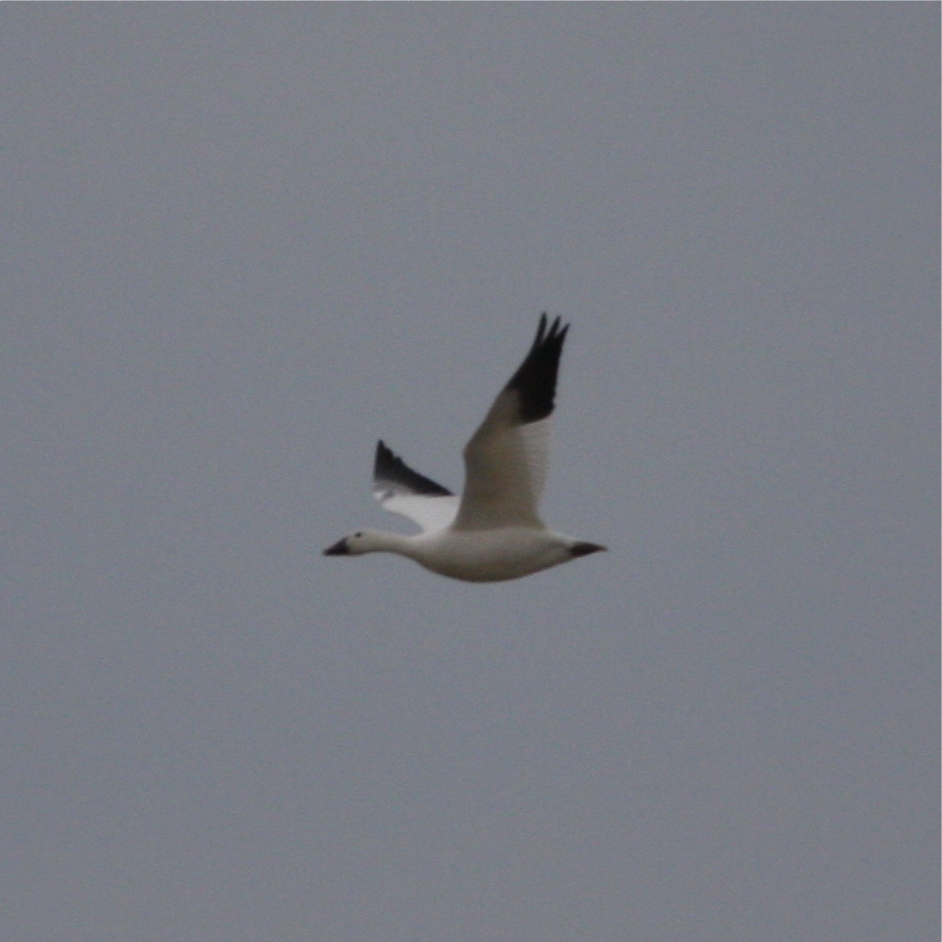
Snow Goose at Balranald 31 March 2013
I haven't done any long-distance twitching for a very long time, preferring birding and bird-finding (or more accurately failing-to-find-birding), but news of a Harlequin Duck just a short drive from our holiday home had me considering a trip to North Uist a good month before our planned holiday. Sense prevailed and I crossed my fingers and amazingly it became a long-stayer. So after a long drive, ferry journey and fairly unceremonious dumping of luggage I headed off to Balranald. As the light faded the difficulty of finding a small duck on a complex rocky shoreline hit home and we returned without a sighting - and we had not managed any of the supporting cast either...
The next morning was a different story entirely. Up early and determined not to dip twice, I was glad to see the female Ring-necked Duck (Scottish tick for me) was viewable on the loch south of the road on the way in. From the track to the beach a distant white goose heading north with a small number of Greylags turned for a lovely flypast and landed in amongst more Greylags in a nearby field (another Scottish tick - well its a little better than the definitely feral ones I've seen in among the small isles..).
If that wasn't enough, the Harlequin (life tick) showed briefly though distantly at Traigh Iar. And then on the way back to the car the Kumlien's Gull made its flypast. What a morning - and all before breakfast - suddenly I can see the attraction of twitching...
Saturday, 24 December 2011
White Christmas: adult Med Gull at Alnwickhill
Another quick trip up to Alnwickhill pays off with an unringed adult winter Mediterranean Gull dropping in to bathe and loaf around with around 100 Black-headed Gulls. Fantastically white winged in flight, the Med Gull has to rank as one of my favourite species; watching it float around in the blustery wind after bathing was particularly enjoyable - particularly as this was the trip to try out the Opticron HDF eyepiece with the Kowa TSN4 scope body. A stunning optical improvement just in time for a stunning gull.
Other Alnwickhill news is that the 5 Canada Geese and 1 hybrid Canada x Greylag Goose have been replaced overnight by 7 Greylag Geese!
Thursday, 20 October 2011
Gorgeous Geese
I realise that this is really letting the side down, but I'm a birder based in Scotland and have never really got into wild goose watching. I have tried. I have sat on the bench at Aberlady at both dawn and dusk to watch the departure and arrival of the Pink-footed Geese. I have watched White-fonts and Barnacles, Brents and Beans. Two years ago to the day I spent a week on Islay with the family hoping that the magic of the barnies would enthuse not only me, but also G and the kids. Well it didn't really work out that way, so I just had to make do with ticking this cracking Cackling Goose in amongst the Barnacle Geese instead (on the assumption it is a genuine trans-Atlantic vagrant)...
On the other hand, I do quite like grilling the feral flocks of geese that are knocking around Edinburgh, checking for oddities. This week I bumped into this odd rufous-tinged Canada Goose.

I had already seen pictures of this bird on Stephen W's blog so was not too surprised to find it at Musselburgh. The unusual coloration of this bird could be the result of staining or some genetic variant. Personally, I was hoping this bird would match some of the interior forms of Canada Goose, such as Todd's, but having had a good trawl of the net I realise that this is not the case. Instead I am now swayed towards Stephen's original diagnosis, which is that the bird is showing staining. This red-brown iron oxide staining is well-known and fairly common in some forms of waterfowl such as swans and snow geese, but is apparently uncommon in Canada Geese - certainly I cannot find any individual with as extensive staining as this bird. Here is an example showing limited staining of the cheek patch, for example.
The earliest reference to an analysis of this staining dates back to 1918 (Ferruginous stains on waterfowl by Frederic Kennard Auk Vol. 35, No. 2). This study, by Kennard, concluded that red-brown staining in wildfowl was the result of iron oxide deposition on the feather surface as a result of digging for food among mud and decayed vegetation. It also noted that Canada Geese were much less likely to be stained than Snow Geese due to their differing feeding habits. (Interestingly, this Canada Goose was the only one observed feeding in amongst the Pink-feet by Stephen...) More recently the staining in Snow Geese has been shown to correlate with summer breeding and feeding origin. If this Canada is showing staining, then I wonder what its summer home is - maybe somewhere up the River Esk, which is pretty rich in iron oxide in places.
There were three other oddities in the flock at Musselburgh - Greylag x Canada Goose hybrids. I managed pictures of two of these. The left hand bird in each photo - but what a rogues gallery these pics are - hybrid geese, feral geese, herring gull, feral pigeon - surely no-one is still reading! See also Stephen W's hybrid geese.
Finally, a real wild goose. A Pink-footed Goose photographed this morning at Musselburgh. Standing on its own at the breakwater, it looked lost and out of place. Some Carrion Crows seemed to think the same, and were giving it occasional tweaks to see if it could become an easy meal. Note that one of the crows had highly leucistic or depigmented wings - how refreshing after all those geese!
On the other hand, I do quite like grilling the feral flocks of geese that are knocking around Edinburgh, checking for oddities. This week I bumped into this odd rufous-tinged Canada Goose.

I had already seen pictures of this bird on Stephen W's blog so was not too surprised to find it at Musselburgh. The unusual coloration of this bird could be the result of staining or some genetic variant. Personally, I was hoping this bird would match some of the interior forms of Canada Goose, such as Todd's, but having had a good trawl of the net I realise that this is not the case. Instead I am now swayed towards Stephen's original diagnosis, which is that the bird is showing staining. This red-brown iron oxide staining is well-known and fairly common in some forms of waterfowl such as swans and snow geese, but is apparently uncommon in Canada Geese - certainly I cannot find any individual with as extensive staining as this bird. Here is an example showing limited staining of the cheek patch, for example.
The earliest reference to an analysis of this staining dates back to 1918 (Ferruginous stains on waterfowl by Frederic Kennard Auk Vol. 35, No. 2). This study, by Kennard, concluded that red-brown staining in wildfowl was the result of iron oxide deposition on the feather surface as a result of digging for food among mud and decayed vegetation. It also noted that Canada Geese were much less likely to be stained than Snow Geese due to their differing feeding habits. (Interestingly, this Canada Goose was the only one observed feeding in amongst the Pink-feet by Stephen...) More recently the staining in Snow Geese has been shown to correlate with summer breeding and feeding origin. If this Canada is showing staining, then I wonder what its summer home is - maybe somewhere up the River Esk, which is pretty rich in iron oxide in places.
There were three other oddities in the flock at Musselburgh - Greylag x Canada Goose hybrids. I managed pictures of two of these. The left hand bird in each photo - but what a rogues gallery these pics are - hybrid geese, feral geese, herring gull, feral pigeon - surely no-one is still reading! See also Stephen W's hybrid geese.
Finally, a real wild goose. A Pink-footed Goose photographed this morning at Musselburgh. Standing on its own at the breakwater, it looked lost and out of place. Some Carrion Crows seemed to think the same, and were giving it occasional tweaks to see if it could become an easy meal. Note that one of the crows had highly leucistic or depigmented wings - how refreshing after all those geese!
Monday, 21 February 2011
Canada Goose x Greylag hybrid
Saw this hybrid Canada Goose x Greylag Goose at Dunsapie Loch today so I thought I would post the photos here. Looks similar, but maybe not identical, to a bird seen recently by SW (see Sedge Warbler blog). It seemed to be part of a definite pair with the Canada Goose in the picture, so maybe there will be some even odder-looking birds around next year. I suppose that could depend on how fertile this interspecific individual is...
"Imagine that, that bird's parents were two different species", I said to my youngest. In return I received a pitying look that said "I know the feeling..."
Labels:
Canada Goose,
Greylag Goose,
Hybrid
Sunday, 6 February 2011
Bean and seen it
Meat Loaf didn't sing 'One out of three ain't bad', because, let's face it, he would have been lying. But in terms of Lothian life ticks it would pretty much sum up my weekend if he had.
Saturday morning and I was passing Linlithgow so I popped in to look for the Smew on the loch. I only had about 20 minutes as I had to get to a meeting elsewhere but I thought it would be long enough to see this regular wintering bird. Nothing doing, and serves me right for not having done my preparation - I'm sure that if I had bothered to find out a little bit about the bird's regular areas on the loch I could have focussed my attention a bit more effectively. Never mind, now that I have dipped on this one, I'll be back... but maybe I won't wait 5 years this time.
Having learned my lesson I made sure the both the OS map and six-figure grid reference were with me for the Taiga Bean Goose near to Whitekirk, East Lothian. A new Lothian species for me, and easily my best views of what often seems to be a particularly shy species. It was keeping company with a single Greylag Goose (rear view below) and a small group of Whooper Swan (right) and Mute Swan (back) and all seemed reasonably relaxed about the nearby cars of birders. Unfortunately the weather conditions were not ideal with grey skies and rain falling.

As the Taiga Bean Goose fed it became clear that it was limping. It is possible that the bird is injured in some way, and it is also possible that an injury might be the reason that it has stuck in this non-traditional wintering site. Either that or some kind soul tried to physically nail the bird down for the week so that weekenders would have a chance to see it!...
What was also slightly strange was the presence of a single Pink-footed Goose (right) in a neighbouring field. By turning through 180° it was pretty much possible possible to compare the finer details of the two closely related species - an added bonus for sure. This must be what the virtual-reality-field-guides of the future will be like! Just to prove that this was some sort of demo of some cyber-ID experience, the Bean Goose then got on with a series of stretching and preening manoeuvres. Each of these showed a different feature of the bird to best advantage, whether the orange legs and feet, or the extent of the orange band and blaze on the bill, or the dark tail narrowly bordered with white, or the white uppertail coverts combined with a black rump and back. Being far more familiar with Pink-footed Geese, this latter feature looked stunning when the Taiga Bean Goose wing flapped (unfortunately I didn't get a shot of this as I was un-fogging lenses at the time... ).As for the third potential Lothian tick, I failed to connect with the mobile Great Grey Shrike that has been frequenting the same general area as the goose. Now, that is definitely another reason to return.
Tuesday, 18 January 2011
Greylag geese at Alnwickhill
During lunchtime I nipped to Alnwickhill Water Treatment Works, which is nearby and a loafing spot for gulls. There were few around today, probably as a result of the heavy machinery operating in the area. Edinburgh's new water supply pipe is being laid just next to the site, and when it is connected the treatment plant will be redundant. Not sure what the various gulls, Northern Lapwings and wildfowl will do then. Certainly, I don't think there will be many suitable alternatives for them in the immmediate neighbourhood. Of course, I think that one of the reasons for the new pipe is the unwanted combination of flocks of birds floating around on Edinburgh's drinking water.
Today's highlight was a small flock of Greylag Geese in a field next to the works. I haven't seen them here before, although I have seen small numbers of Canada Geese on the filter beds.
Of course Greylag Geese can be seen year round at Duddingston Loch at the base of Arthur's Seat, and that is probably where these birds are from. I do see the Duddingston birds over the house fairly frequently.
On the other hand, they just might be real wild birds born and bred in Iceland. I do see skeins of those (I presume) high overhead once in a while, though not as often as the Pink-footed Geese.
Today's Greylags certainly looked a bit smarter and behaved a bit wilder than this bird I photographed at Duddingston Loch earlier in the year. It was suffering from a deformity or damage to its bill which appeared to be giving it some trouble preening - a very unkempt look indeed.
Today's highlight was a small flock of Greylag Geese in a field next to the works. I haven't seen them here before, although I have seen small numbers of Canada Geese on the filter beds.
Of course Greylag Geese can be seen year round at Duddingston Loch at the base of Arthur's Seat, and that is probably where these birds are from. I do see the Duddingston birds over the house fairly frequently.
On the other hand, they just might be real wild birds born and bred in Iceland. I do see skeins of those (I presume) high overhead once in a while, though not as often as the Pink-footed Geese.Today's Greylags certainly looked a bit smarter and behaved a bit wilder than this bird I photographed at Duddingston Loch earlier in the year. It was suffering from a deformity or damage to its bill which appeared to be giving it some trouble preening - a very unkempt look indeed.
Subscribe to:
Posts (Atom)