Showing posts with label South Africa. Show all posts

Thursday, 1 November 2012

Martial Eagle, Liwonde, Malawi


I think that this is one of those archetypal birding safari shots - a Martial Eagle glaring down at the camera from its perch. What is difficult to appreciate from the shot is the scale of the bird in question. In life it appeared about the same size as an elephant - in the photo it appears about the same size as a Common Buzzard. The reality is somewhere between the two. If you are struggling to get the scale, just check out those talons...


While this was a very close encounter, and exciting too, especially for those in the party who had never seen such a big bird so close, I can't help but re-post another shot of a hunting Martial Eagle that I took in KwaZulu Natal a few years ago. I love the way it looks bigger than the rhino!


Tuesday, 20 December 2011

Hartlaub's Gull at Robben Island


I was trawling through some pictures from a 2007 trip to South Africa and found a picture of this Hartlaub's Gull taken on Robben Island off Cape Town. I had forgotten that I had kept a shot of this species as gulls are clearly not the main focus of attention of any visit to Robben Island - the tour from a former inmate was an unforgettably moving experience and the shot below captures some of the grim reality for those imprisoned on the island.


On return to Cape Town, these sealions provided much needed light relief after an intense day focusing on human resilience in the face of oppression.


Monday, 24 October 2011

African anthus armchair tick?

With the flock of 3 Richard's Pipits at Aberlady I managed some good looks at this species for the first time (although, predictably enough, my shots are nowhere near as good as some of those on Birding Lothian). As I mused that I have managed to catch up with very few large pipits over the years I remembered this unidentifed Anthus that I photographed in Hluhluwe, South Africa in April 2007.


On that trip I had been overwhelmed by amazing mammals and jaw-dropping birdlife - larks and pipits had been firmly relegated to their little brown job status and this photograph has remained unidentified ever since. It would definitely be a tick for me, but the challenge is can the species be determined from this single image? The contenders, in descending order of likelihood could be African Pipit, Long-billed Pipit, Buffy Pipit and Plain-backed Pipit. Any ideas?

Whether it is identifiable or not, its presence was eclipsed by a pair of Martial Eagles mating nearby and a close fly-past by a squadron of White-backed and White-headed Vultures. No offence to the pipit, but watching amazing raptors to a backdrop of white rhino is birding KwaZulu Natal style!


Tuesday, 8 February 2011

Square-tailed armchair tick

Thanks to a comment made by BirdBoyBowey in a BirdForum thread, a previously unrealised tick came my way today in the form of a Square-tailed Nightjar (also known as Mozambique Nightjar) I photographed this bird in Imfolozi in South Africa in April 2007. I'd seen a few Fiery-necked Nightjars on the night drives but this one was the first to allow close-range photography - it seems that in my excitement I didn't bother to identify it! That said, the spotlight does make some of the bird's ID features a little more difficult to see, but surely that all white outer tail feather is unmissable!... Must do better next time...


Now off to a SOC talk by Ken Shaw - now he is not the type to make this sort of error, so I had better listen very closely...

Saturday, 15 January 2011

Here's hoping...

So, a Slaty-backed Gull has finally been seen in Britain, with a bird found in Rainham, London, yesterday and confirmed today. Well done to Dominic Mitchell of Birdwatch magazine for being the first to find this long-awaited Pacific species. Since it is unlikely that I'll be making my way down to London to see this bird, I'm hoping that it takes a shine to capital cities and heads up to Edinburgh (though I do hope it hangs around for those who are travelling to see it this weekend).

For gull seekers there are still plenty of species that haven't yet been seen in Britain. With every new addition, the list of possibles somehow seems to increase, as the vagrancy potential of the larger and more robust species is underlined. One species that appears to be spreading in this direction is the Kelp Gull, a southern hemisphere species that has colonised coastal Senegambia and now been recorded in Morocco. How long before the first European record I wonder? That said, it would be fairly easy to overlook... Here are a couple of shots of a moulting adult and a first winter along with some other species typical of the Cape of Good Hope, South Africa. All pictures taken in April 2007.

This adult bird is re-growing its outer primaries so it has an atypically blunt-winged look. Note also that the fresh feathers have much larger white tips than on the birds illustrated in Olsen and Larsson's Gulls.
The full length of the primaries of the first winter (2CY) Kelp Gull can be seen in the first shot of this below. Note the typically dull leg colour of this species, which is greenish grey in the adult.
Of course, I didn't quite manage a decent shot of this admittedly rather grotty looking gull as I was having much more fun photographing the awesome African Penguins at their Boulders Beach breeding colony.
 
 
All the birds in the area, including the Black OystercatcherCommon Fiscal Shrike or Red-winged Starling below, seemed to have had the same make-over - all monochrome with an accent colour or bit of artistic shading!

 
And finally, what could be more appropriate at the Cape of Good Hope?


Friday, 10 December 2010

Grip and cryptic tick?

We were stopped by the Yosemite National Park Police in mid-April this year. At night. In a blizzard.

"Could I ask why you haven't fitted your snowchains?"

Easy answer, of course... "we don't have any..."

Now I am not advocating travelling in Yosemite without snowchains - it turns out it costs hundreds of dollars to get an emergency set fitted in Yosemite. At night. In a blizzard.

And my Monterey Bay pelagic had been cancelled that same day due to the same terrible weather...

To top it all a snow plough (or snow plow, I suppose) passed just as we had the chains fitted and completely cleared the inch of slush from the road. The brand new chains then slapped and ground against the wet tarmac all the way to Yosemite Lodge, and we never needed to use them after that...

...until, of course, this week in Edinburgh. On Monday of this week in a far worse blizzard than we experienced in Yosemite, it turned out the snowchains were worth their weight in gold!


As expected, the scenery of Yosemite was fantastic, and especially so with the snow blanket. Over the next couple of days the skies cleared to reveal a truly awe-inspiring landscape.


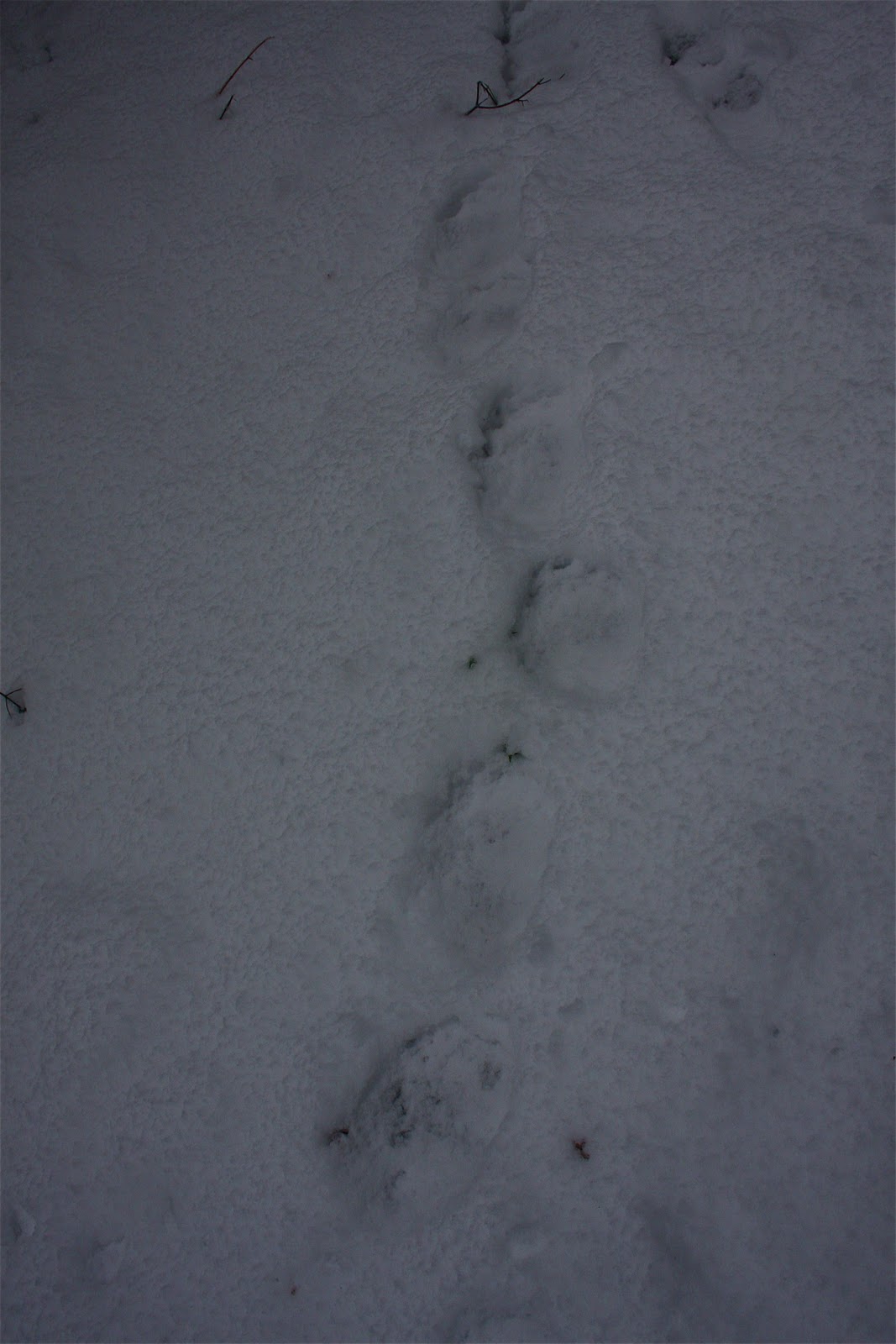
With the snow cover we were able to do some mammal tracking. In both of the cases below we had had the advantage of seeing their owner before we saw their tracks - which kind of defeats the purpose of tracking I suppose.

The Black Bear (left) walked past our accommodation as we were unpacking the car in the dark. This unexpected visit was pretty hair-raising at the time – we didn't hang around to photograph it but instead ran screaming to our room...

Next day, we jammed in on seeing a Bobcat (right). It sprang in a beautiful arc from a fallen tree trunk that was lying partway across a river. It leapt from what appeared to be a standing start several metres across the water and then slinked away into the undergrowth. A brief but spectacular sighting.


Birdwise, Yosemite was quiet, as can be expected at the time of year, given the altitude and the difficult weather conditions. The weather also changed our plans and restricted our movements. I was pretty gripped off not to be able to fit in a trip to try to see Great Grey Owl, one of my 'most-wanted' birds.

The corvids, on the other hand, were of good value, with both Steller's Jay and Common Raven both being relatively tame and sufficiently abundant for regular sightings. There are several subspecies of Steller's Jay and the form found in California (Cyanocitta stelleri frontalis) is distinguished by the blue streaks on the forehead.


The Raven would be of the subspecies Corvus corax principalis, which has a large bill and very glossy plumage. However, mitochondrial and chromosomal DNA evidence indicates that the 'Californian Raven' clade is a cryptic species that shares a more recent common ancestry with the Chihuahuan Raven rather than with the Holarctic clade of the Common Raven elsewhere in the Northern hemisphere. This DNA evidence suggests that the two clades of Common Raven split about 2 million years ago (which would coincide with the onset of an ice age), and the ancestors of the Chihuahuan Raven then splitting from the 'Californian Raven' about 1 million years ago. Subsequent to this it appears that while the more recent split has resulted in clear speciation between Chihuahuan and Californian birds, the Holarctic and Californian clades are now re-merging through interbreeding.

Whether the above individual is a 'Californian Raven' or not I do not know... according to the original paper (top link below) there is a chance of 27 in 28 based on their 28 samples. That said, they also speculate that the Californian clade may have been a low altitude and desert dwelling form and the Holarctic form a high altitude mountain form. The above bird was certainly photographed in the latter habitat.

The following bird, on the other hand, was photographed along the spectacular coast at Point Reyes. This lowland location makes this bird more likely to be a 'Californian Raven'. Note that this individual has clearly been used in a radio-tracking study by the Point Reyes Bird Observatory. Now, I wonder whether anyone has DNA tested this bird?...


A subsequent study (second link below) has also found strong support for the relationships described above between the Holarctic clade and the Californian and Chihuahuan clade. What is more, it found that the Holartctic clade of Common Ravens also includes the ancestors of the Pied Crow.

So, in summary, the Common Raven, below left (photographed on Islay with Common Jackdaws for scale!), shares a more recent ancestry with the Pied Crow, below right (photographed in South Africa), than it does with the 'Californian Raven' above. Similarly the 'Californian Raven' shares a more recent ancestry with the Chihuahuan Raven. Yet, despite this, the Common Raven and the 'Californian Raven' have not diverged sufficiently to prevent successful breeding between the two clades.


http://www.ncbi.nlm.nih.gov/pmc/articles/PMC1690844/?tool=pmcentrez

 http://onlinelibrary.wiley.com/doi/10.1111/j.1463-6409.2005.00182.x/abstract


Finally, here is a scan of a photograph that I took in Lanzarote, Canary Islands in the pre-digital era.

This is a 'Canary Island Raven' (Corvus corax tingitanus), which is small, brown and oily rather than glossy. Mitochondrial DNA evidence suggests that this could well be a distinct species from the Holarctic clade of Common Raven. So that looks like a cryptic 'tick'...