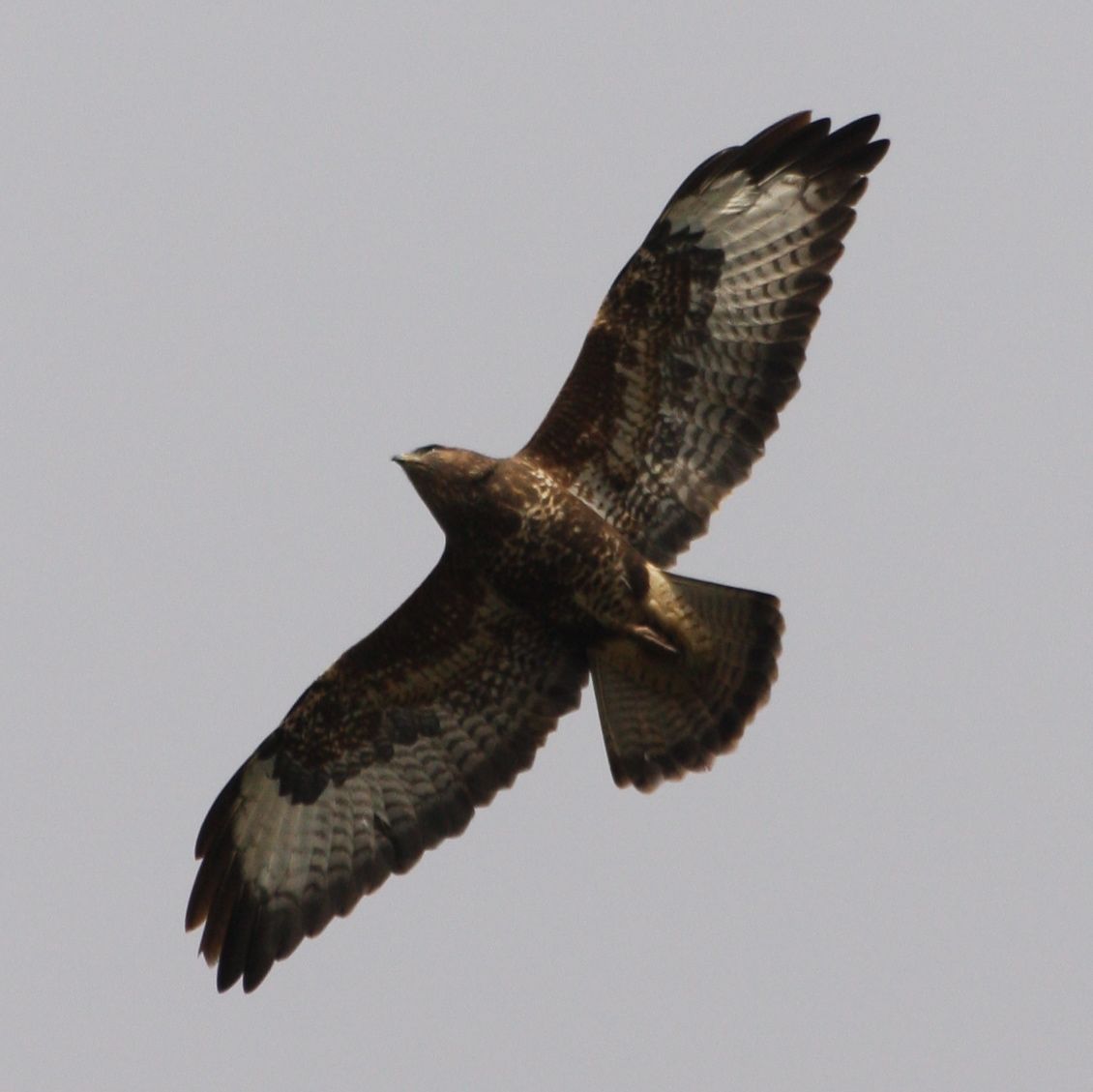
Showing posts with label Common Buzzard. Show all posts

Thursday, 1 August 2013

Long-legged Buzzard/Gibraltar Buzzard? El Rocio, Donana, Spain 18 July 2013


The Atlas Long-legged Buzzard Buteo rufinus cirtensis is little known in terms of its identification and distribution. Not only is it similar is size and structure to the Common Buzzard but there are suggestions that the two forms hybridise. With photos of the quality of the first three here an identification is not safe but I'm going to stick my neck out and suggest that this adult bird that I photographed a couple of weeks ago at El Rocio in the Coto Donana is an Atlas Long-legged Buzzard. This ID is tentative but based on the apparent leg length in the perched shots, the tail pattern in the flight shot below and some of the plumage features of the underwing...

Since writing this post earlier today I have become aware that there is considered to be a possible Long-legged x Steppe (?) Buzzard hybrid swarm of buzzards known as the Gibraltar Buzzard that has recently been identified in southern Spain. Presumably this bird is one of these...


Whether this nearby juvenile has any Atlas Long-legged Buzzard genes in it I'm even less sure about...


Sunday, 23 October 2011

East coast migrants due tomorrow...


Well that's what the weather charts are saying. I birded at Torness this morning. The only obvious migrant landbirds appeared to be a sprinkling of Robins along the foreshore. I have never been confident that I am able to tell the difference between continental and local Robins. So this bird could have arrived from across the North Sea, or not... Only other migrant passerine was what may have been a (lapland?) bunting, but it flew through without calling. Always exciting to watch something coming 'in off' even when no ID is possible.

Seawatching was more productive with a single juv Long-tailed Skua heading north, the only identifiable skua out of around a dozen. Not a close view (as seems to have been my luck with skuas this season), but its Kittiwake-size, tern-like flight action and dithering progress all classic jizz for this species. Also offshore at least 3 Little Gulls in among the Kittiwakes, a Manx Shearwater heading south and a couple of Puffins on the sea. Diver movements were poor with just three Red-throated Divers seen in 2 hours (one shown below).


Finally some raptor action as I popped into Barns Ness on the way home - a nice adult Common Buzzard being mobbed by a pair of Kestrels.


Note the newly growing primary coming through on the bird's left wing. Also two different ages of secondaries visible. Nice solid terminal tail band on this bird.


Sunday, 15 May 2011

Bateleur-a-like tail-less Common Buzzard

What a weird bird today over Mortonhall, Edinburgh - an almost completely tail-less Common Buzzard. Superficially Bateleur like in appearance but not really as exciting to watch... Nevertheless, not something I have seen before. I can only wonder what has caused this loss of tail feathers and hope that it is not a sign of persecution...


Friday, 6 May 2011

Tree Pipit: patch tick

A quick walk around Alnwickhill this evening produced 4 Tufted Duck on the water works and male Kestrel carrying prey. That's fine, I thought, enough to keep me going until I get out birding later in the weekend. In the meantime I was idly marvelling at the reproductive capacity of rabbits as witnessed by the sudden appearance of a multitude of small bunnies hopping around in the fields, when I noted an odd wing movement in the distance. As if on cue, a Common Buzzard was trying to balance while pinning one of the aforementioned and now writhing bunnies to the top of a telegraph pole. Within moments a Carrion Crow was on the scene and the Buzzard headed off carrying its prey.

Last leg of the walk and I was hoping for a Grasshopper Warbler in a patch of scrub when a pipit flushes out of the edge of a grassy field. Silent, and just fractionally bulkier than the Meadow Pipits that were in the same area only a few weeks ago, its more direct flight immediately suggested Tree Pipit. Sure enough it headed for a nearby thick hedge where it showed a nice contrast between the heavier breast streaking and narrow flank streaking (just visible in this heavily cropped shot). It then flew again and I assumed it was gone, but instead it turned and headed back towards its original location and landed in among the gorse scrub.

A careful stalk gave me a good view as it sat up in a broom plant for a couple of minutes. Not the best angle for viewing perhaps, but from the photos it is probably possible to discern the narrow flank streaking, curved hind claw, supercilium behind the eye, pale cheek spot and slightly stouter bill of this species. There appears to have been a strong passage of Tree Pipits through Lothian this spring. As a breeding species the Tree Pipit seems unaccountably rare in the region. Even though this is the first individual I have seen at the patch, there is a good amount of what appears to be suitable habitat in the Alnwickhill, Braids and Hermitage areas of Edinburgh and as the species can be unobtrusive unless singing I would assume that this species is a regular migrant in the area.


Adult and juvenile Common Buzzard comparison


I am quite a fan of Common Buzzards and, like many folk these days, can see them from the garden most days of the week. This shot was taken last week and I have posted it as it shows a nice comparison of adult and juvenile structure.

 
In the picture above, the adult (above left) shows a nicely parallel wing shape, solid dark trailing edge to the flight feathers, evidence of moult in the flight feathers and a broadly based slightly shorter tail. The juvenile (lower right) has a narrower hand so a distinct S-shape to the trailing edge of the wing, no clear dark trailing edge to the wing feathers, no clear evidence of moult (i.e. all flight feathers of a similar age) and a narrower, longer tail. The juvenile has an altogether more harrier-like jizz in this picture. 

Some of these details may be clearer in these cropped images. Once again the adult is shown above the juvenile.


These differences are less distinct when birds are moving away from the observer, as shown in this shot. The more distinct trailing edge of the flight feathers in the adult is still obvious in direct comparison.

Monday, 25 April 2011

Common Buzzard kicks Golden Eagle in the head

This was probably one of the more surprising encounters last week on Harris, Western Isles - for the Golden Eagle that is. The Common Buzzard caught the eagle unaware and scored a direct hit! I'll bet that doesn't happen too often...


Once bitten, twice shy, perhaps...


Sunday, 10 April 2011

More smaller raptors

Weather-wise a stunning day, but maybe a little too still and lacking in rain for good numbers of migrants... Though I am not complaining as I managed a couple of barbeques and took the opportunity to sort out some long-overdue gardening. Chiffchaffs singing all day in the neighbourhood - they will move on before long. Also a Willow Warbler singing at 7:00 am just up the road, while another realised that it had miscalculated its destination and upped and was off flying at about 15m off the ground strongly due North. Presumably it wasn't planning on keeping that up for long on a hot sunny day...

Raptors were in evidence today with multiple sightings of at least 4 Common Buzzards and 2–3 Sparrowhawks. Here is a nice male Sparrowhawk. It could be the same bird that I photographed last year, but if it is it has developed a nice red eye in the meantime.


After yesterday's Kestrel, I assumed that another sighting of one passing over the garden today would be the same individual, but the photos show otherwise. Then later on another passed over moving due North at a reasonable altitude - this latter bird at least presumably a migrant.


This is the first of today's Kestrels. A female-type bird perhaps, in comparison to yesterday's male. It would be nice if they found each other and hung around...


Finally, a couple of Common Buzzards with feather characteristics that should make them reasonably easy to identify in the short term. The first has a missing tail feather and the second is missing the tips to primaries 7 and 8 on both wings. If I do not see these birds again in the near future then maybe it would be evidence of passage?


All very well, but there are a few other raptors found in Scotland that could in theory pass overhead - a White-tailed Eagle was seen again in East Lothian today for example. I think it will take some luck to see one of those from here, so maybe I'll have to take a visit to Highlands and Islands instead?...

Friday, 8 April 2011

More raptors

I managed to see a new species for the garden yesterday - Sand Martin (73rd species). Well, to be honest, I have seen several Sand Martins over the garden over the last few summers but never more than fleeting 1 second glimpses. While under most circumstances that is long enough to identify this species' distinctive flickering flight, I have never considered these views to be either sufficiently definitive to be worthy of elevation to Garden List Status. Yesterday that status changed as a line of 4 Sand Martins appeared one after the other dashing westwards just above the rooftops and long enough for me to get my bins on them. Since then I have seen more of this species passing by. The burden of proof required is now lower and I have twigged that since they are low fliers - they will hug the contours even if they are are rooftops...

A couple of nice raptors also passed over today. First a male Kestrel powered low over west and thoughtfully circled once for good measure. With just a handful of sightings each year, usually of distant birds, these are the best shots I have managed from the garden (!). Note that the tail of this bird appears to resemble that of Lesser Kestrel. Other photos show that today's bird had one tail feather longer than the others and its protrusion accounted for this illusion.


The other raptor was this nice Common Buzzard. It is probably the palest bird that I have seen from the garden - quite unlike most other individuals that I have seen in the area. It looks to me like a 2nd calendar year bird with its smart juvenile flight feathers and coverts.


Wednesday, 30 March 2011

Skywatching for Big Birds

There have been a spate of records of big birds in the area recently. It all started with an escaped White Stork which was reported on 18th March in fields to the south of Edinburgh. News then filtered through that it reportedly flew over the house (although I wasn't at home at the time...). Two days later a Golden Eagle was also reported heading over Liberton. This news was a bit of a blow, especially since I worked out that I was out in the garden at the time... Not to be outdone, a White-tailed Eagle (presumably from the reintroduction programme) and a Common Crane have also been reported along the East Lothian coast.

So with all these big birds around what have I managed to see skywatching in the garden? Err, not much, although the first Common Linnets and Meadow Pipits of the year have started passing over the garden in the last week or so, and I have managed a garden tick in the shape of a squadron of Goosanders overhead (71st species for/from the garden). Most interesting, perhaps, was a Common Buzzard overhead on the 23rd March - a dark 3rd calendar year bird moulting into adult plumage with a wing shape and flight action reminiscent of a Golden Eagle. I would not be surprised if a poor view of this bird was the origin of of the eagle report a couple of days earlier (though I have no information on that report, so this is pure speculation, of course).


Saturday, 5 March 2011

Buzzards over the garden


With spells of settled sunny weather the Common Buzzards have been more obvious soaring over the garden than for the last few weeks. Here are some shots of a darkish first winter bird (2CY) that has passed over a couple of times recently.


I am quite a fan of these juvenile Buzzards - they have a different silhouette to the adult birds, with longer tail and bulging secondaries compared to their narrower inner primaries. Here is a paler juvenile that passed over in September. Like the bird above, the less heavily marked trailing edge to the wing is another distinction from the adults.

This adult shows the contrasting darker trailing edge to the wing and slightly longer inner primaries and shorter tail giving the bird a more compact and less rangy appearance in flight.

Sunday, 16 January 2011

A buzzard's tail

I have been trying to get a photograph of this Common Buzzard's uppertail for quite a few weeks. After having seen an intriguing buzzard at Barn's Ness earlier in the autumn, I thought I would try spend more time studying the plumage of the local birds.

This regular bird in the Hermitage of Braid, Edinburgh, caught my attention with its clean white underwings. This feature, combined with its apparently rufous uppertail, is more typical in eastern forms (vulpinus). Of course the plumage of Common Buzzard is very variable and the compact structure of this individual tells us that it is likely to be a local bird (buteo). That it is not particularly massive suggests that it is possibly a male.

This photo was taken in early December. The pale flight feathers with fine bars may be more typical of vulpinus than buteo, but the dark brown rather than reddish coverts along with the diffuse border of the dark trailing edge of the wing are more typical of buteo. Structurally it appears to be a perfect buteo, with no suggestion of vulpinus. Notice that it has lost the tip of primary 9 on its left wing.


I next managed to see the same bird a month later - its missing primary tip obvious as it passed over. The pale flight feathers were emphasised by the dark trailing edge but the uppertail and upperwing was not visible.
 The following day it drifted past again over a ridge.
 This time I glimpsed some complex upperwing detail.
 Then it lost some height and gave a quick hint of a rufous tail before disappearing behind trees.


The next sighting was earlier this week. The buzzard was the target of this mass mobbing event by 20 Carrion Crows, 6 Rooks and 4 Jackdaws. I left them to it as I felt that the bird already had enough problems without me adding to them.

Finally, today I managed to get a reasonable view of the uppertail as well as a couple of record shots. My suspicion that the bird had some rufous in its tail proved correct.
The shots with the spread tail show that the outer web of each feather has darker pigmentation, whereas each inner web is reduced in dark pigment and appears whiter and allows the underlying rufous colouration to show through. This, I think, is a fairly common tail pattern in buteo. Nevertheless, this tail, when combined with strong pale bases of the primaries made for a surprisingly contrasty upperpart colouration - well worth the patient stalk in my opinion.