A couple of weeks ago I mentioned on the blog that I had visited Duddingston to try to 'fluke a Bittern'. Not having seen one at the site for around 16 years I was a little surprised when one was reported at the site a few days later. Despite a few folk searching it stayed well hidden (probably up at the west end) until yesterday when it was accidentally flushed and moved down to the east end of the loch.
I decided to make a dash there today after work. Apparently it had been seen on and off all day and I was delighted to pick it up skulking in the reeds as soon as I started using my scope. It was hunting just behind the outermost reeds and when stationary was virtually invisible thanks to its awesome camouflage. I watched for about 40 minutes by which time it was beginning to get dark and then unexpectedly was treated to a sudden 'bitterning' neck stretch and brief flight view. Sadly the light was well gone by then, so the flight shot is a little blurry (1/4 of a second at ISO800 - not the best choice of settings!!..). If you can't make it out it is flying to the right with green legs trailing behind it - the wings have ghosted out but the body and neck are, errr..., sort of visible... honest... Ah well, next time for the photography perhaps.
Tuesday, 7 February 2012
Monday, 6 February 2012
Free flying Night Herons at Edinburgh Zoo
A visit to Edinburgh Zoo with work allowed me to catch up with both free-flying Night Herons today. These birds are thought to be around 18 and 25 years of age (see here) and are presumably regular visitors to the Zoo's sealion enclosure. Well, that's where they were today, both sitting sunning themselves in the Scot's pine overhanging the pool. I did not have time to check them thoroughly for rings, but from their beak deformities they should be individually identifiable with ease.
The first pic shows a bird with a crossed bill tip with a slightly protruding lower mandible. I assume it has two colour rings on its left leg.
This second bird has an overbite and may well be ringed on both legs, but I was unable to spend the time required to check. Here are some pictures I found on a photography forum of what appear to be the same two birds taken in March of last year.
These Night Herons are of the North American subspecies hoactli, so here is a shot of a real wild hoactli taken in Monterey Harbour, California in April 2010. Its beak is certainly a little more appropriately shaped... The differences between this race and the European subspecies are subtle, but the shape of the cap and thickness of the white line above the eye differ, as does the colour of the bare parts in the breeding season apparently.

Finally, a shot of one of the new residents...
The first pic shows a bird with a crossed bill tip with a slightly protruding lower mandible. I assume it has two colour rings on its left leg.
This second bird has an overbite and may well be ringed on both legs, but I was unable to spend the time required to check. Here are some pictures I found on a photography forum of what appear to be the same two birds taken in March of last year.
These Night Herons are of the North American subspecies hoactli, so here is a shot of a real wild hoactli taken in Monterey Harbour, California in April 2010. Its beak is certainly a little more appropriately shaped... The differences between this race and the European subspecies are subtle, but the shape of the cap and thickness of the white line above the eye differ, as does the colour of the bare parts in the breeding season apparently.

Finally, a shot of one of the new residents...
Saturday, 4 February 2012
Woodcock in off sea at Torness
This Woodcock was one of two that I watched coming in-off the North Sea at Torness. One bird was seen at distance but this one was much more cooperative. First seen far out and low over the sea, I then watched transfixed as it made a bee-line towards me. It ended up passing within a couple of metres... These birds are likely escaping the freezing conditions setting in on the continent. Another was under the trees nearby at the waterfall though I only saw it in flight.
Only other landbird in-off was a Woodpigeon which strikes me as unusual. Not sure I have seen one coming in from so far out before...
Tuesday, 31 January 2012
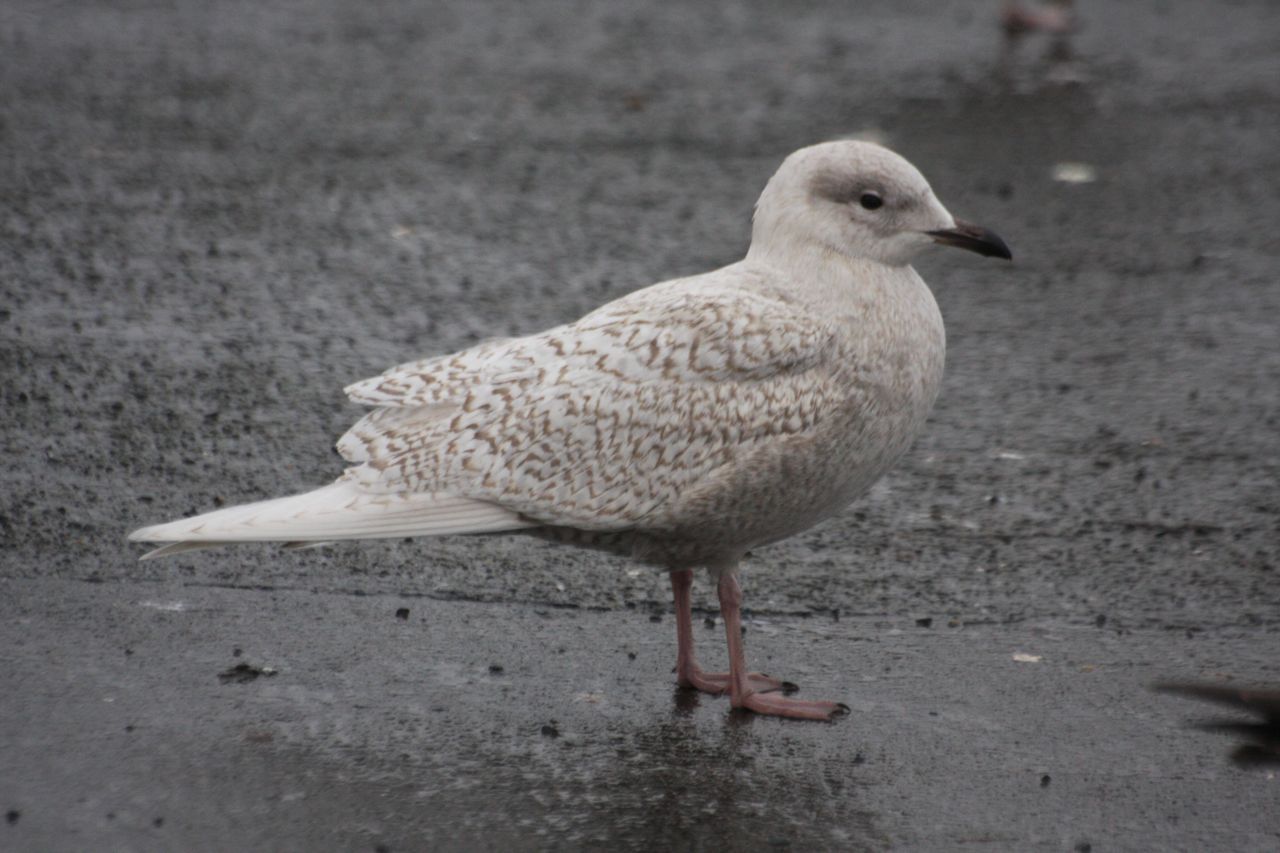
1st winter Iceland Gulls, Galway
With at least 8 Iceland Gulls being reported at a landfill site in West Lothian today, maybe the Iceland Gull invasion is about to reach us in Edinburgh. There have only been a couple of reports of singles along the coast, but it would be great to catch up with this species again soon. In the meantime here are some pictures of a variety of first winter birds from Nimmo's Pier in Galway at the beginning of the month.

This last bird is a nice dark, coarsely marked individual.
Although I have not managed any Icelands in Lothian this year so far, I did manage a couple of larid year ticks last weekend - Kittiwake and Little Gull both viewed distantly feeding at the sewage works outfall at Seafield. Best bird of the weekend, however, was the female Blackcap that appeared in the garden in time to be logged for the garden birdwatch - the first I have seen there all winter!

This last bird is a nice dark, coarsely marked individual.
Although I have not managed any Icelands in Lothian this year so far, I did manage a couple of larid year ticks last weekend - Kittiwake and Little Gull both viewed distantly feeding at the sewage works outfall at Seafield. Best bird of the weekend, however, was the female Blackcap that appeared in the garden in time to be logged for the garden birdwatch - the first I have seen there all winter!
Thursday, 26 January 2012
Smew and Wood Duck at Linlithgow
Last weekend I decided to take a stroll around Linlithgow Loch. A lovely location and a spot of great historical importance, my motivation was related more directly to the presence of the female Smew (just visible above), which has wintered at the site for several years. A Lothian tick for me, I did feel that I owed it a visit.Also of interest at the loch side was this (presumed escapee) female Wood Duck. The ring has appeared on its leg since its arrival at the loch apparently.
A male has been seen not far away apparently - here is one photographed in California in 2010.
Monday, 23 January 2012
Colour ringed Black-headed Gulls at Alnwickhill
I have been searching for readable colour rings on gulls at Alnwickhill for over a year. In that time I have only managed a single read - a Herring Gull in November 2010 (ringed in Gloucestershire). Other than that I have seen unreadable Herring Gulls and and some partially read Norwegian Common Gulls. Yesterday I had already had a typical encounter with a white-ringed (Norwegian?) Black-headed Gull on the Aberlady shore - it was too flighty and distant for its code to be read.
It was with a little shock then later at Alnwickhill that I noted that one of the nearest Black-headed Gulls was white colour ringed. As I set up my scope I was confused to see that the ring had suddenly changed both leg and colour! Wow, two colour-ringed Black-headed Gulls...
So, it turns out that the white-ringed JHR4 (on the right of the pictures) was ringed in Oslo, Norway, in March 2011 and the blue-ringed 2C13 (on the left) was ringed at Killington in Cumbria in June of the same year. Interesting that they should both be spending their time in winter in Edinburgh and a great surprise for me to find both at the same time.
It was with a little shock then later at Alnwickhill that I noted that one of the nearest Black-headed Gulls was white colour ringed. As I set up my scope I was confused to see that the ring had suddenly changed both leg and colour! Wow, two colour-ringed Black-headed Gulls...
So, it turns out that the white-ringed JHR4 (on the right of the pictures) was ringed in Oslo, Norway, in March 2011 and the blue-ringed 2C13 (on the left) was ringed at Killington in Cumbria in June of the same year. Interesting that they should both be spending their time in winter in Edinburgh and a great surprise for me to find both at the same time.
Sunday, 22 January 2012
Lothian year list hits 100 with Water Rail
I have been lucky to manage some great birding over the last couple of weekends, and as a result my yearlist topped 100 today. I started the day on 98 and headed first for Duddingston to listen for Water Rail and maybe fluke a Bittern. No luck on either so I nipped into Figgate Park. Four Goosander and a singing Dipper were nice, but no sign of the Kingfishers or Shoveler, my two target species, so no additions to the year list there.
En route to Aberlady Bay, I had a quick seawatch from Ferny Ness. Some Long-tailed Ducks were showing well, but the water was a little choppy and four kite surfers were doing their wildlife-scaring best to reduce our local biodiversity. A quick stop at Seton failed to produce any Mediterranean Gulls but a group of about 25 Golden Plovers were whizzing around - a nice surprise 99th Lothian species for the year.
As I pulled into Aberlady Bay, I felt sure that I would soon hit the 100 mark. The tide was extremely far out so I decided to leave scanning the estuary for another time. Instead I thought I could head towards the dunes. As I hit the sea buckthorn tunnel I thought about the number of times I had walked through it always in the hope of stumbling upon some unusual avian waif. Well I wasn't expecting a Water Rail but there it was in the middle of the path as I rounded a corner. It scuttled into the buckthorn and I assumed that was it, but in fact it seemed quite happy for a few minutes as it wended its way deeper and deeper into the tangle. Not great views, and certainly not great shots, but a great bird to hit the hundred with!
Well, that's what the slog is for, eh?, views like that!...
There were three more year ticks ahead today. The trek out to the dunes was rewarded with several Sanderling on the beach, a family walk later in the day added a Lesser Redpoll at the Union Canal, and finally at dusk a cracking winter adult Mediterranean Gull heading East past Seafield Road. It was not quite the white-winger that I was hoping for (a Glaucous Gull had been reported earlier) but I was certainly not complaining!
En route to Aberlady Bay, I had a quick seawatch from Ferny Ness. Some Long-tailed Ducks were showing well, but the water was a little choppy and four kite surfers were doing their wildlife-scaring best to reduce our local biodiversity. A quick stop at Seton failed to produce any Mediterranean Gulls but a group of about 25 Golden Plovers were whizzing around - a nice surprise 99th Lothian species for the year.
As I pulled into Aberlady Bay, I felt sure that I would soon hit the 100 mark. The tide was extremely far out so I decided to leave scanning the estuary for another time. Instead I thought I could head towards the dunes. As I hit the sea buckthorn tunnel I thought about the number of times I had walked through it always in the hope of stumbling upon some unusual avian waif. Well I wasn't expecting a Water Rail but there it was in the middle of the path as I rounded a corner. It scuttled into the buckthorn and I assumed that was it, but in fact it seemed quite happy for a few minutes as it wended its way deeper and deeper into the tangle. Not great views, and certainly not great shots, but a great bird to hit the hundred with!
Well, that's what the slog is for, eh?, views like that!...
There were three more year ticks ahead today. The trek out to the dunes was rewarded with several Sanderling on the beach, a family walk later in the day added a Lesser Redpoll at the Union Canal, and finally at dusk a cracking winter adult Mediterranean Gull heading East past Seafield Road. It was not quite the white-winger that I was hoping for (a Glaucous Gull had been reported earlier) but I was certainly not complaining!
Saturday, 21 January 2012
Hybrid Crow at Burdiehouse
Spent an hour at Burdiehouse today looking through the flocks of corvids, pigeons, finches and buntings that are currently feeding in the stubble. A great concentration of granivorous birds, and one that must be bringing in more raptors than the single Sparrowhawk I managed.
Highlight for me was this hybrid Carrion x Hooded Crow as it was by far the most 'Hooded' individual that I have seen in the area. The features that distinguish it from a pure Hoodie are the black feathers in the vent, scapulars, rump and axillaries. Certainly this bird is much closer to the Hooded Crow end of the spectrum than Carrion Crow!
Friday, 20 January 2012
2nd winter Iceland Gull, Galway
Like many of the Iceland Gulls of this winter's invasion into north-western Europe, this big 2nd winter bird was clearly hungry and showed little fear of me. Almost Glaucous Gull-like in character, I assume from its size that it was a male bird.


Thursday, 19 January 2012
Water Pipit at Barns Ness
Just a few poor shots of one of the Barns Ness Water Pipits photographed last Saturday. I think that there were probably two, but could not be sure as I couldn't manage both in view at the same time.
This bird seemed very relaxed for a Water Pipit - it certainly did not disappear over the horizon as soon as it was spotted, which is a trait that often seems to come to the fore with this species.

Stuart
Here are some shots of (possibly the same?) Water Pipit at Barns Ness on 31 March last year... Very poor shots, but some indication of how much the plumage will change in the next few months.
This bird seemed very relaxed for a Water Pipit - it certainly did not disappear over the horizon as soon as it was spotted, which is a trait that often seems to come to the fore with this species.

Stuart
Here are some shots of (possibly the same?) Water Pipit at Barns Ness on 31 March last year... Very poor shots, but some indication of how much the plumage will change in the next few months.
Subscribe to:
Posts (Atom)