Saturday, 31 March 2012

Snow Bunting and Fulmar: 2 garden ticks today!

Full of the cold, I decided to spend the morning in bed and then spend the afternoon on 'light duties' in the garden. I was expecting some raptors, and sure enough Buzzard, Sparrowhawk and even Peregrine obliged (I missed the Osprey that may have passed over en route to Duddingston today). I was not expecting to extend the garden list, last added to in August with a nocturnal fly-over Whimbrel, although it would be fair to say that there is always hope.

As it happens it was double whammy today, with flyover Snow Bunting and Fulmar (species nos 76 and 77).

The former was ID'd on call only - despite searching I couldn't pick it/them up as they passed over North.

The latter passed over fairly low while I was 'resting' with my eyes fixed upwards - it took a few moments to realise that the funny Fulmar-like gull was in fact a Fulmar! The quick record shot has to rank as one of the worst Fulmar pics ever loaded onto the web I would guess. I think that my excitement has reduced the image to a blur, which is surprising given that this was possibly one of the most-likely additions to the garden list (the Crags are not too far away - I had even considered trying for those birds through the scope from the garden at some point - something that will not be required now...).


Tuesday, 27 March 2012

Escaped Eastern Rosella

A colleague told me that his neighbour had photographed a parrot in his garden in Swanston, Edinburgh, yesterday. I was keen to see the pics and here they are. Looks like an Eastern Rosella to me, although I have no experience of these antipodean beauties, so maybe someone else will correct me if I am wrong.


It would be a nice surprise to see one of these in Edinburgh, although I would imagine that the owner might not share that thought. And maybe the bird wouldn't be too pleased about its new circumstances depending upon how conditioned it was to cage or aviary life.

I suppose that escaped parrots are seen every year or so in Edinburgh. I have managed to see a couple of Cockateils in Edinburgh over the years although neither has hung around for long - especially the one that was sitting on my window ledge one morning when I opened the curtains... Below is a composite image of one that I saw at Musselburgh heading North across the Forth in August 2010.

Sunday, 25 March 2012

Spring has arrived


A Chiffchaff was singing in the back garden first thing yesterday morning. Maybe the haar was so thick it couldn't really tell where it was but it moved on pretty sharpish!

Today was beautifully sunny and I spent some time in the garden in the afternoon. It has been all work recently but even still I felt a little guilty lying down for a spot of skywatching. Hoping for an early Osprey or a white-winged gull but not really expecting to see anything of note I hadn't even bothered to fetch the camera. Of course I wish I had now as a cracking Merlin motored north at about 5:30pm. The third I've seen from the garden, this one flew North along a route that was an almost perfect repeat of the bird I saw in equally hot and clear weather on 10 April 2011 - I wonder if it was the same bird? A great sighting and really makes up for the absence of Lothian birding for me over the last few weeks.

Only other recent notable sightings were on a work trip up to the Glenshee area last weekend. Some fantastic white Ptarmigan moulting into their summer plumage along with plenty of Mountain Hares, looking similarly out of place.


Wednesday, 8 February 2012

Free-flying Night Heron colour rings

I was back at Edinburgh Zoo today. Once again I did not have time to do more than fire off some quick shots of the free-flying Night Herons on my way in, and this time, out of the zoo. This time, though, I made sure to get shots of the colour rings, so here they are along with information kindly supplied by Stephen Welch, Lothian Recorder.

First two shots are of the "ancient bird red-green left (the green is actually blue, but appears green; formerly also red right)". This bird has an overgrowing upper mandible. Is there a radio transmitter tucked under its tertial feathers? Can't be sure from these pictures. Nevertheless this is thought to be the 25 year old individual.


Secondly here are two shots of the other bird with the lower mandible overgrowth. This is the "younger yellow-blue vertically split band bird". The blue half of the band is facing away from the camera, but close examination of the full photographs reveals a few telltale blue pixels (see crop right). Notice that it also appears to have damaged toes/lost toe nails. This bird is assumed to be 18 years old.


Also at the zoo an unexpected year tick in the form of a Green Woodpecker in the trees on Corstorphine Hill to the east of the Living Links centre. To round off the day I decided to walk home from work through the Hermitage of Braid. I had seen a suspected Water Rail there on the 25th January and although I had checked the spot a couple of times since then it was not until today that I finally had a conclusive view of this skinny skulker.

Tuesday, 7 February 2012

Bittern: believe it or not!

A couple of weeks ago I mentioned on the blog that I had visited Duddingston to try to 'fluke a Bittern'. Not having seen one at the site for around 16 years I was a little surprised when one was reported at the site a few days later. Despite a few folk searching it stayed well hidden (probably up at the west end) until yesterday when it was accidentally flushed and moved down to the east end of the loch.


I decided to make a dash there today after work. Apparently it had been seen on and off all day and I was delighted to pick it up skulking in the reeds as soon as I started using my scope. It was hunting just behind the outermost reeds and when stationary was virtually invisible thanks to its awesome camouflage. I watched for about 40 minutes by which time it was beginning to get dark and then unexpectedly was treated to a sudden 'bitterning' neck stretch and brief flight view. Sadly the light was well gone by then, so the flight shot is a little blurry (1/4 of a second at ISO800 - not the best choice of settings!!..). If you can't make it out it is flying to the right with green legs trailing behind it - the wings have ghosted out but the body and neck are, errr..., sort of visible... honest... Ah well, next time for the photography perhaps.

Monday, 6 February 2012

Free flying Night Herons at Edinburgh Zoo

A visit to Edinburgh Zoo with work allowed me to catch up with both free-flying Night Herons today. These birds are thought to be around 18 and 25 years of age (see here) and are presumably regular visitors to the Zoo's sealion enclosure. Well, that's where they were today, both sitting sunning themselves in the Scot's pine overhanging the pool. I did not have time to check them thoroughly for rings, but from their beak deformities they should be individually identifiable with ease.


The first pic shows a bird with a crossed bill tip with a slightly protruding lower mandible. I assume it has two colour rings on its left leg.

This second bird has an overbite and may well be ringed on both legs, but I was unable to spend the time required to check. Here are some pictures I found on a photography forum of what appear to be the same two birds taken in March of last year.

These Night Herons are of the North American subspecies hoactli, so here is a shot of a real wild hoactli taken in Monterey Harbour, California in April 2010. Its beak is certainly a little more appropriately shaped... The differences between this race and the European subspecies are subtle, but the shape of the cap and thickness of the white line above the eye differ, as does the colour of the bare parts in the breeding season apparently.


Finally, a shot of one of the new residents...


Saturday, 4 February 2012

Woodcock in off sea at Torness

This Woodcock was one of two that I watched coming in-off the North Sea at Torness. One bird was seen at distance but this one was much more cooperative. First seen far out and low over the sea, I then watched transfixed as it made a bee-line towards me. It ended up passing within a couple of metres... These birds are likely escaping the freezing conditions setting in on the continent. Another was under the trees nearby at the waterfall though I only saw it in flight.


Only other landbird in-off was a Woodpigeon which strikes me as unusual. Not sure I have seen one coming in from so far out before...


Tuesday, 31 January 2012

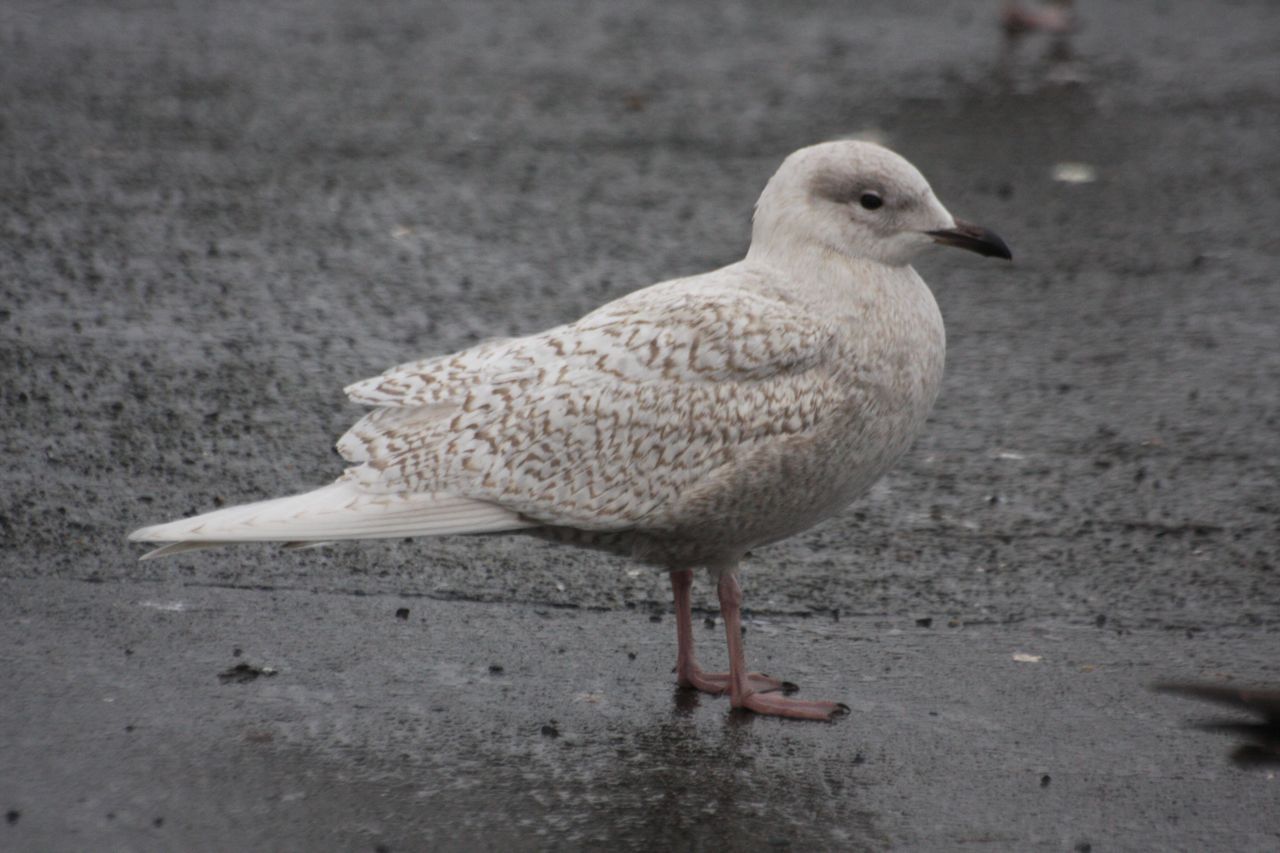
1st winter Iceland Gulls, Galway

With at least 8 Iceland Gulls being reported at a landfill site in West Lothian today, maybe the Iceland Gull invasion is about to reach us in Edinburgh. There have only been a couple of reports of singles along the coast, but it would be great to catch up with this species again soon. In the meantime here are some pictures of a variety of first winter birds from Nimmo's Pier in Galway at the beginning of the month.


This last bird is a nice dark, coarsely marked individual.

Although I have not managed any Icelands in Lothian this year so far, I did manage a couple of larid year ticks last weekend - Kittiwake and Little Gull both viewed distantly feeding at the sewage works outfall at Seafield. Best bird of the weekend, however, was the female Blackcap that appeared in the garden in time to be logged for the garden birdwatch - the first I have seen there all winter!

Thursday, 26 January 2012

Smew and Wood Duck at Linlithgow


Last weekend I decided to take a stroll around Linlithgow Loch. A lovely location and a spot of great historical importance, my motivation was related more directly to the presence of the female Smew (just visible above), which has wintered at the site for several years. A Lothian tick for me, I did feel that I owed it a visit.


Also of interest at the loch side was this (presumed escapee) female Wood Duck. The ring has appeared on its leg since its arrival at the loch apparently.


A male has been seen not far away apparently - here is one photographed in California in 2010.


Monday, 23 January 2012

Colour ringed Black-headed Gulls at Alnwickhill

I have been searching for readable colour rings on gulls at Alnwickhill for over a year. In that time I have only managed a single read - a Herring Gull in November 2010 (ringed in Gloucestershire). Other than that I have seen unreadable Herring Gulls and and some partially read Norwegian Common Gulls. Yesterday I had already had a typical encounter with a white-ringed (Norwegian?) Black-headed Gull on the Aberlady shore - it was too flighty and distant for its code to be read.

It was with a little shock then later at Alnwickhill that I noted that one of the nearest Black-headed Gulls was white colour ringed. As I set up my scope I was confused to see that the ring had suddenly changed both leg and colour! Wow, two colour-ringed Black-headed Gulls...


So, it turns out that the white-ringed JHR4 (on the right of the pictures) was ringed in Oslo, Norway, in March 2011 and the blue-ringed 2C13 (on the left) was ringed at Killington in Cumbria in June of the same year. Interesting that they should both be spending their time in winter in Edinburgh and a great surprise for me to find both at the same time.